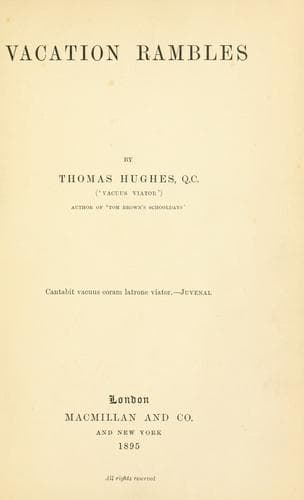
Europe -- Description and travel; United States -- Description and travel
I had noted Derry as one of the places to be seen on account of the
siege, and accordingly went there, to get another startling sensation.
Like most other folk, I suppose, I had always looked on the story as
interesting and heroic, and had wondered in a vague way how some 30,000
men, commanded by a distinguished French soldier, and a considerable
part of them at any rate well-equipped regular troops, could have been
kept at bay for ten months by a mere handful of regulars, backed by the
’prentice boys of the town and neighbourhood. Religious zeal was no
doubt a strong factor on the side of the town, and Parson Walker, a born
leader of men, “with a bugle in his throat,” like “Bobs.” But when one
remembers that no provision had been made for a siege, that many of
the leading men were for opening the gates, and indeed that the French
officers and James’s deputy were actually within 300 yards in their
boats, to accept the surrender, when the ’prentices rushed down and
shut and manned the gates, and then looks at the scene on the spot, one
is really dumbfounded, and wanders back in thought to King Hezekiah and
Jerusalem. From the Cathedral, which dominates the city, you can trace
distinctly the line of the old walls, and can hardly believe your eyes.
The space enclosed cannot be more than a quarter of a mile in length, by
some 300 yards in breadth (I could not get exact measurements), and in
it, including garrison and the country folk who had flocked in, were
more than 30,000 people. It was bombarded for eight months, during
at least the last four of which famine and pestilence were raging.
No wonder that the parish registers tell of more than 9000 burials
in consecrated ground, while “the practice of burial in the backyards
became unavoidable!” Where can such another story be found in authentic
history? Parson Walker, let us say, fairly earned his monument.
I must own to grievous disappointment as to the farming in Ulster. All
through the South and Centre I had seen the hay in the fields in small
cocks in September, and the splendid ripe crops of oats and barley
uncut, or, if cut, left in sheaf, or being carried in a leisurely
fashion, which was quite provoking, while tall, yellow ragweed was
growing in most of the pastures in ominous abundance. That will all be
altered, I thought, when I cross “Boyne Water.” Not a bit of it! Here
and there, indeed, I saw a good rick-yard and clean fields, but scarcely
oftener than about Cork or Killarney, and no one seemed to mind any
more than the pure southern Celts. One man said, when I mourned over
the ragweed three feet or four feet high, that he did not mind it, as it
showed the land was good! As to leaving hay in cock, well that was
the custom--they would get it into stack after harvest, any way before
Christmas; as to dawdling over cutting and carrying, well, with prices
at present rates, what use in hurrying? There was a comic song called
“Clear the Kitchen,” popular half a century ago, which ran--
Public-domain text, read in full here on John Shaqi.
Reviews
Reviews
No reviews yet
Be the first to share your thoughts on this work.
Elsewhere in the archive
Join the Discussion
Join the discussion
Sign in to leave a comment or review.
Sign InorCreate an account