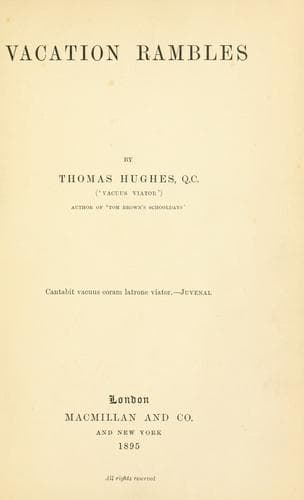
Europe -- Description and travel; United States -- Description and travel
I saw an old man come riding by.
Says I, “Old man, your horse will die”;
Says he, “If he dies I’ll tan his skin,
And if he lives I’ll ride him agin.”
It fits the Irish temper, North and South, pleasant enough to travel
amongst, but bad, I should think, to live with.
“Panem et Circenses”, Rome, 21 st April 1895.
I have been asking myself at least a dozen times a day during the
last fortnight, why Rome should be (to me, at any rate) the city of
surprises, far more than Athens or Constantine, for instance, or
any other city or scene of world-wide interest in Europe or America.
Jerusalem and the Nile cities I have never seen (and fear I never shall
now). Surely, to what I take to be the majority of your readers, who
have gone through, as I have, the orthodox educational mill--public
school and college--precisely the contrary should be true. We spent no
small part of from six to ten years of the most impressionable time of
our lives in studying the story of the Mistress of the Old World, from
Romulus and Remus to the Anto-nines. Even the idlest and most careless
of us could scarcely have passed his “greats” without knowing his
geography well enough to point out on the map the position of each of
the seven hills, the Forum, the Janiculum, the Appian Way, the Arch of
Titus, the Colosseum, etc., and must have formed some kind of notion
in his own mind of what each of them looked like. At any rate, I had
no excuse for not knowing my ancient Rome better than I knew any modern
city, both as to its geography and the politics, beliefs, and habits
of its citizens; for I was for two years in the pupil-room of a teacher
(Bishop Cotton) who spared no pains, not only on the texts of Livy,
Horace, Sallust, and Juvenal, and the geography, but in making the Rome
of the last years of the Republic and the first Caesars live again for
us. For instance, he would collect for us all the best engravings then
to be had (it was before the days of photographs) of Rome, and show us
what remained of the old buildings and monuments, and where the Papal
city had encroached and superseded them; and again, would take infinite
pains to explain the changes in the ordinary life of the Roman citizen,
which had been creeping on since the end of the third Punic war, when
her last formidable rival went down, and the struggle between patrician
and plebeian had time and opportunity to develop and work itself out,
till it ended in the Augustan age, when the will of the Cæsar remained
the sole ultimate law, in Rome, and over the whole Empire. Of course the
explanation of the phrase “Panem et circenses,” and the growth of
the system, in the shape of public feastings, shows, baths, and other
entertainments, with which each successful Tribune or General, as he
came to the front, and the Cæsars after them, tried to bribe and sway
the mob of the Forum, formed no small part of this instruction. One item
Public-domain text, read in full here on John Shaqi.
Reviews
Reviews
No reviews yet
Be the first to share your thoughts on this work.
Elsewhere in the archive
Join the Discussion
Join the discussion
Sign in to leave a comment or review.
Sign InorCreate an account