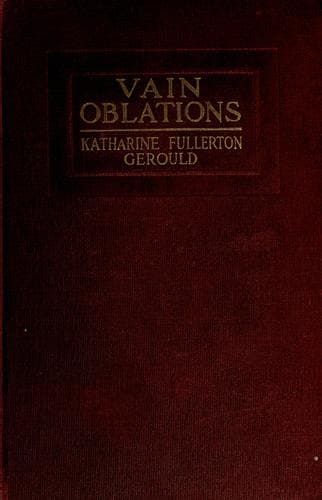
American fiction -- 20th century; Short stories, American
Hoyting dropped his chin on his breast and narrowed his eyes. Then he
shook his head very slowly. “At my time of life it’s silly to be always
saying how strange things are, and how clever life is, and all that
literary nonsense; but, on my word, if ever a scene was arranged to make
a man a protagonist in spite of himself, this was it. Every element in
that Dakar situation was contrived to bring Paramore out. He had fever
and the prescience of death--which is often mistaken, but works just as
well notwithstanding; he had performed his extraordinary task; he was in
love with Madame Pothier. The cup was spilling over, and I was there to
wipe up the overflow.”
Hoyting was silent for a moment. Then he spoke irritably.
“I don’t know where to begin. There isn’t any beginning to this story.
It hasn’t any climax--or else it’s all climax. It’s just a mess. Well, I
shall have to begin, I suppose, if Paramore didn’t. Perhaps the first
thing was his sitting up in bed one morning and peering out at me
through his mosquito-netting. It gave him a queer, caged look. His voice
went with it--that cracked and throaty voice they have, you know. ‘Do
you know Whitaker?’ he asked.
“‘No, indeed,’ I said. ‘You’d better lie down.’
“If you could have seen him then, you’d have felt, as I did, that he’d
better not talk; that he wouldn’t say anything one wanted to hear.
“‘It was Whitaker that finished me.’ Still he peered out at me.
“‘You’re not finished.’ I remember lying quite peevishly about it. He so
obviously _was_ finished.
“‘Yes, I am. And Whitaker did it. Oh, I mean I really did it.’
“I give you my word that he was startling, with that unnatural voice,
that cunning look in his eyes the sick often get, and those little white
cross-bars pressed against his face.
“‘Lie down,’ I said again. ‘What did Whitaker do?’
“He shook his head a little, and the netting moved on his face. It was
horrid.
“‘He told them I couldn’t have done the stuff I’d brought back.’
“‘Did he know?’
“‘He didn’t know anything about folk-lore, but he did know where I’d
been.’
“He spoke so impersonally that it led me on to ask questions. After all,
I had told Madame Pothier I would stay with him through the morning,
and I had to make the time go somehow for both of us. It was remittent
fever without the chills, and there were fairish mornings at first. The
afternoons and nights, when the malady rose like a wave and broke
horribly after midnight--oh, those were bad. Madame Pothier and the
regimental doctor took care of those. It looked fairly hopeful when he
arrived, but finally all the worst symptoms came out, and before the end
it was very bad. It was one of those cases that might, at the last, be
yellow fever and just technically isn’t. Poor Paramore! Did I say that
his face looked as old as all time under that shock of sun-bleached
hair? It did.
Public-domain text, read in full here on John Shaqi.
Reviews
Reviews
No reviews yet
Be the first to share your thoughts on this work.
Elsewhere in the archive
Join the Discussion
Join the discussion
Sign in to leave a comment or review.
Sign InorCreate an account