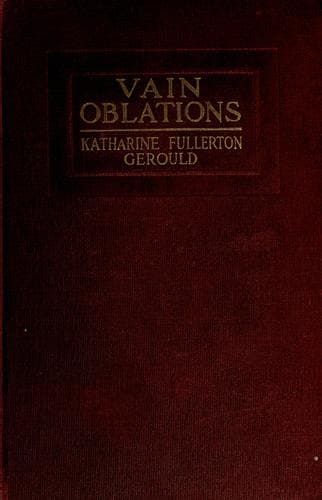
American fiction -- 20th century; Short stories, American
“I got all this that I’ve been telling you, in bits and snatches, while
I sat with him. The fever didn’t seem so bad at first--the doctor
thought we could pull him through. You absolutely never know. I never
thought he would pull through. Those very first questions of his, when
he sat peering out at me through the mosquito-netting of his bed, didn’t
seem to come from a man who had life before him. And when I had got
those early details out of him, I somehow felt sure he’d go. I’m no
pessimist; but I didn’t see life giving him a second chance. It was too
much to hope that life would let him make good after all. And yet--he so
nearly did. Damn fever!...
“Madame Pothier did everything she could. She was a good sort. I’ve
always wondered, as much as it is permitted to wonder, whether she felt
anything for Paramore. If she did, I am sure that she never knew it.
There are women like that, you know. I don’t mean the women who gaze out
of cold, sexless depths at the fires burning above, and wonder
pruriently why the fires burn. She wasn’t that kind. I mean the women
who, when they become wives, remain women only for their husbands. I
don’t believe it would ever have occurred to her that any man save
Marcel Pothier could look upon her with romantic interest. I don’t
pretend to understand the phenomenon, but I know that it exists. A woman
like that simply assumes that she is no longer a wandering lure
constantly crossing the path of the male. She thinks all men’s eyes are
veiled because hers are. A very pretty, pathetic ostrich trick.
Sometimes it doesn’t work, but astonishingly often it does. With
Paramore it did. All I mean is that she hadn’t dreamed Paramore
worshipped her. She remembered him as a friend they had made two years
before, and of course he was to come to them out of that pitiful Mission
Hospital. No one in Dakar knew anything about Paramore’s fiasco. He
wasn’t precisely famous, you see. Dakar was perfectly provincial. And
Paramore was hoping, I dare say, that he could stave off the tale of his
lie until he could lay before her the news of his atonement as well. The
hardest thing he had to bear, probably, was dying and leaving his story
to the telling of chance tongues, not knowing in what form it would
eventually come to her. That, I am convinced, is why he told me so
much--let his parched lips articulate those memories for me. But not
once did he break down and ask me to tell her. Oh, I’ve good reason for
respecting Paramore--a second-rate respect it must always be, I dare
say, granted that extraordinary crumpling-up in Australia. But he never
crumpled up again.
“For a day or two he hung in the balance. Then, after one exceedingly
bad night, which left Madame Pothier blue under her fine eyes and white
round her carved lips, he had his last coherent hours on earth....
Public-domain text, read in full here on John Shaqi.
Reviews
Reviews
No reviews yet
Be the first to share your thoughts on this work.
Elsewhere in the archive
Join the Discussion
Join the discussion
Sign in to leave a comment or review.
Sign InorCreate an account