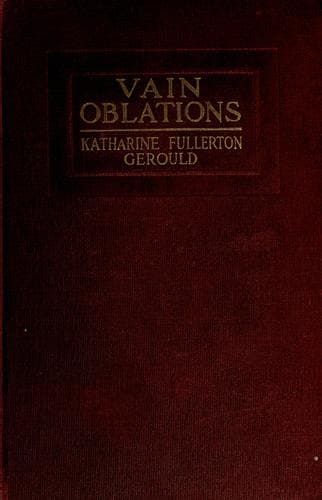
American fiction -- 20th century; Short stories, American
Saxe slept, I say; and at dawn woke to his problem. The intelligence
that works for us while we sleep waked him into the conviction that he
must, at any cost, buy the woman. He said that, as he strode over to the
chief’s hut, he was thinking only of what price he ought to put on the
child that would be such a fantastic mixture of breeds. He did not want
the woman, but he felt that the purchase was inevitable. This, I am
convinced, was only the New English leaven working him up to martyrdom.
It would be unmitigatedly dreadful to have the woman on his hands, and
therefore he ought probably to buy her.
The chief greeted him with temper, and soon Saxe learned why. The woman
had left the hut before dawn, taking with her her master’s largest
knife. She was found later in her own little hovel, dead, with a clean
stab to her heart. Suicide is virtually unknown among savages, and the
village was astir. Saxe asked to see the body at once, but that, it
seems, was not etiquette: he had to wait until it was prepared for
burial. For an instant, he said, he thought of bargaining for the body,
but forebore. He had a difficult return journey to make, and the point
was, after all, to see it. When they permitted him to enter the hut, the
face had been piously disfigured beyond recognition. He told me that he
lifted the tattooed hand and kissed it: he did not know why. It was
clear that if the woman had--preposterously--been Mary, she would not
have wished it; and if she were the other, it was almost indecent. But
he could not help it. This impulse of his seems to have been his only
recognition of Mary Bradford. In life and in death, she suppressed
every sign of herself with consummate art.
We were a fevered group that waited for Saxe day after day at the
Mission; and he seemed to have been gone an intolerably long time. The
broken leg that had kept me from going with him was almost well when he
returned. Yet he had taken the shortest way back. It was also the
unhealthiest. He said that he had heard war rumors that made him avoid
the more frequented trail, but I fancy he rather hoped that the swamps
he clung to would give him fever. In that sense--and in that sense
only--Saxe could perhaps be said to have committed suicide. He stumbled
into the Mission dining-room at noon one day. “And Mary?” we all cried,
rising. “Oh, did you expect to see Mary?” he asked politely, but with
evident astonishment.
Public-domain text, read in full here on John Shaqi.
Reviews
Reviews
No reviews yet
Be the first to share your thoughts on this work.
Join the Discussion
Join the discussion
Sign in to leave a comment or review.
Sign InorCreate an account