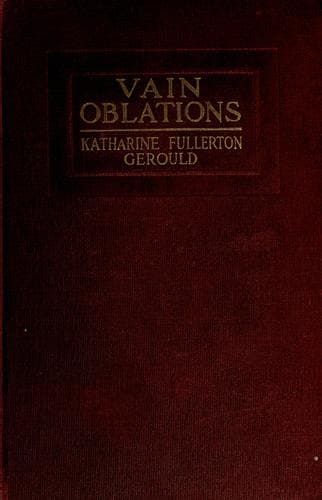
American fiction -- 20th century; Short stories, American
His vain attempt at Ollendorfian flatness broke down: the mere facts
seemed so very much against him. He had often complained to Marty Martin
that it was dashed awkward, this being the only original changeling;
but, in point of fact, he had never been so uncomfortable in his life as
now, at the prospect of playing the authentic filial rôle. “I’ll make
her dine here,” he muttered. He could think of nothing worse without
being actually disrespectful. An old lady in a gray shawl walked slowly
down the hall past the door, and it suddenly struck him that his mother
would perhaps like to dine at the St. Justin. “I ought to have cabled to
ask what color _her_ shawl would be,” he began, in a flippant whisper,
to himself. The flippant whisper stopped. He was much too genuinely
nervous to be flippant any longer without an audience. At the same time,
he found himself wondering--oh, insincerely, theatrically, rhetorically
wondering--why he had not bought an etiquette book. There was
something--well, to be honest, something like an extra gland in his
throat, something like a knot in his healthy young nerves--that kept him
from putting the question to himself audibly. “If she cries--” he
reflected, with anticipatory vindictiveness. What he really meant was:
“If she makes me so much as sniff.” For your mother was really the one
person in the world who had you necessarily at a disadvantage. Even if
you hadn’t the habit of her, you couldn’t count on yourself for
reticence. You might be as bored as possible, but that wouldn’t save
you. There might be treacheries of the flesh, disloyalties of the
cuticle--all manner of reversions to embryonic helplessness. She somehow
had your nerves, your physical equilibrium, at her mercy. Old Stein,
prodding at you with instruments in the psychological laboratory, was a
mere joke in comparison. Even the most deceived, the most docile and
voluble student ended respectably in a card catalogue. Peter felt
suddenly an immense tenderness for the decencies, the unrealities of
“science.” But to meet your mother in conditions like these was the real
thing: the naked horror of revelation. “It’s literature,” thought Peter
to himself, “and what is literature but just the very worst life can
do?” He came back to his familiar conclusive summary. It _was_ rum.
Public-domain text, read in full here on John Shaqi.
Reviews
Reviews
No reviews yet
Be the first to share your thoughts on this work.
Join the Discussion
Join the discussion
Sign in to leave a comment or review.
Sign InorCreate an account