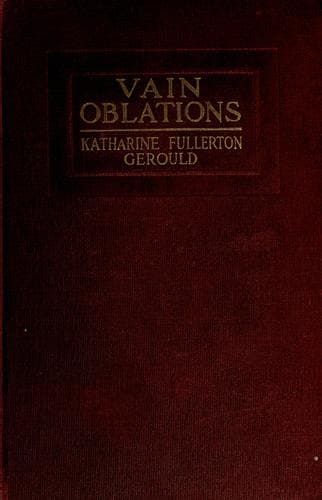
American fiction -- 20th century; Short stories, American
It was less the loyal friend than the loyal son; but he was still,
dining that night at Plon’s (he wondered where the deuce she was
dining), very much under her dominion. She had brought with her a rare
illumination. He would never forget her voice and her veiled eyes. He
hadn’t dreamed a woman could suggest her love in so many silent ways.
She just _was_ adoration, implicit and incarnate. It was tremendous to
have seen it. The white light it threw on Lawrence’s bride! The white
light it threw, for that matter, on all the women he knew! He felt
himself bursting with knowledge.
It was not until after dinner, indeed, that he realized just how
wonderful in another way she had been, and with how little knowledge of
another sort she had left him. She had told him absolutely nothing. So
far as he was concerned, her narrative had only concealed events. He
couldn’t remember whether New Zealand had followed or preceded Chile;
and his sincere impression was that it didn’t matter, even to them.
Anything that in all those years _had_ mattered, had been dropped away
out of sight between her sentences. If he had been by his hour both
racked and inebriated (for that was what his state of tension amounted
to), it was not because of any facts she had given him. She had not even
answered his plain questions. She had left him in dismay as soon as he
had begun to ask them. He saw that now, though in his simplicity he
hadn’t seen it before. He had been sacrificed again, as he had always
been sacrificed. His mystery was still his mystery, and he was still
left alone with his monstrous hypotheses. He wouldn’t have missed it for
anything--not even for good old Marty. But he turned to Marty at last
with compunction.
“Marty, old man,” he said, “it _was_ rum.”
THE WINE OF VIOLENCE
I am an old man now, and, like many other old men, I feel like making
confession. Not of my own sins. I have always been called, I am well
aware, a dilettante, and I could hardly have sinned in the ways of the
particular sinners of whom I am about to speak. But I have the
dilettante’s liking for all realities that do not brush him too close.
Throughout the case of Filippo and Rachel Upcher, I was always on the
safe side of the footlights. I have no excuse for not being honest, and
I have at last an excuse for speaking. It is wonderful how the death of
acquaintances frees one; and I am discovering, at the end of life, the
strange, lonely luxury of being able to tell the truth about nearly
every one I used to know. All the prolonged conventional disloyalties
are passed away. It is extraordinary how often one is prevented from
telling the blessed truth about the familiar dead because of some
irrelevant survivor.
Public-domain text, read in full here on John Shaqi.
Reviews
Reviews
No reviews yet
Be the first to share your thoughts on this work.
Join the Discussion
Join the discussion
Sign in to leave a comment or review.
Sign InorCreate an account