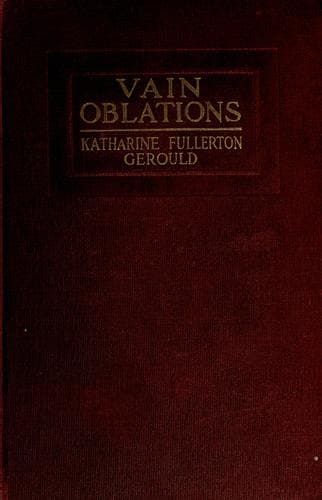
American fiction -- 20th century; Short stories, American
Never had an inheritance come so pat as mine. There were all sorts of
places I wanted to go to, and now I had money enough to do it. The
_wanderlust_ had nearly eaten my heart out during the years when I had
kicked my heels in that third-rate legation. I wanted to see Lithway,
but a dozen minor catastrophes prevented us from meeting during those
breathless weeks, and as soon as I could I positively had to be off.
Youth is like that. So that, although Lithway’s bereavement had been
very recent, at the time when I was in America settling my affairs and
drawing the first instalment of my beautiful income--there is no beauty
like that of unearned increment--I did not see him until he had been a
widower for more than two years.
The first times I visited Lithway were near together. I had begun what
was to be my almost life-long holiday by spending two months alone--save
for servants--on a house-boat in the Vale of Cashmere; and my next
flights were very short. When I came back from those, I rested on level
wing at Braythe. Lithway was a little bothered, on one of these
occasions, about the will of a cousin who had died in Germany, leaving
an orphan daughter, a child of six or seven. His conscience troubled him
sometimes, and occasionally he said he ought to go over and see that the
child’s inheritance was properly administered. But there was an aunt--a
mother’s sister--to look after the child, and her letters indicated that
there was plenty of money and a good lawyer to look after the
investments. Since his wife’s death, Lithway had sunk into lethargy. He
had enough to live on, and he drew out of business entirely, putting
everything he had into government bonds. When he hadn’t energy enough
left to cut off coupons, he said, he should know that it was time for
him to commit suicide. He really spoke as if he thought that final
indolence might arrive any day. I read the aunt’s letters. She seemed to
be a good sort, and the pages reeked of luxury and the maternal
instinct. I rather thought it would be a good excuse to get Lithway out
of his rut, and advised him to go; but, when he seemed so unwilling, I
couldn’t conscientiously say I thought the duty imperative. I had long
ago exhausted Germany--I had no instinct to accompany him.
Public-domain text, read in full here on John Shaqi.
Reviews
Reviews
No reviews yet
Be the first to share your thoughts on this work.
Join the Discussion
Join the discussion
Sign in to leave a comment or review.
Sign InorCreate an account