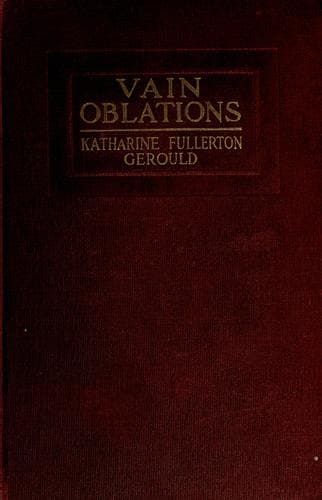
American fiction -- 20th century; Short stories, American
He asked to see her. Oh, certainly; before purchasing he should see her.
But meanwhile there was the official cheer to taste--_kava_, above all,
inimitably mixed--and she should be fetched. Where was she? A young
slave girl suggested sardonically that she was probably at her toilet.
Since she had heard of the white man’s coming--Saxe had tactfully sent
a runner ahead of him--she had been smearing herself meticulously with
ochre and other precious pigments. This was said with a sidelong glance
at the chief: obviously, he distributed those precious pigments only to
his favorites. Saxe said that from that moment his heart misgave him. He
had been somehow sure that this woman was Mary. Why his heart should
have misgiven him, I do not know; or what devil of stupidity put it into
his head that this was the trick of a half-breed slave to make herself
irresistible to a white man. It sounded to him, he said, like the
inspiration that would naturally occur to the daughter of an Arab by a
Mandingo woman. It has never sounded to me in the least like that. He
said that he still believed it was Mary; but I fancy he believed it
after the fashion of the doubter who shouts his creed a little louder.
Of course there was something preposterous in the idea of Mary
Bradford’s making herself barbarically _chic_ with ochre to greet the
lover who might be coming to rescue her. But was not the whole thing
preposterous to the point of incredibility? And Mary Bradford was not an
ordinary woman--not the yellow widow of a Portuguese pearl-fisher. It
has always seemed to me that poor Saxe ought to have realized that.
Saxe consumed _kava_ until he could consume no more. Then the slave girl
announced that the woman had been found. Saxe rose to his feet. He was
stifling in the great hut, where all the chief councillors had joined
them at their feast, where the reek from greased bodies seemed to mount
visibly into the twilight of the great conical roof. His head was
reeling, and his heart was beating weakly, crazily, against his
ribs--“as if it wanted to come out,” he said. His hands were ice-cold.
He had just presence of mind enough to drag the black interpreter out
with him, and to leave one of his own men inside to watch the stuff with
which he proposed to pay. The chief and most of his councillors remained
within.
Public-domain text, read in full here on John Shaqi.
Reviews
Reviews
No reviews yet
Be the first to share your thoughts on this work.
Join the Discussion
Join the discussion
Sign in to leave a comment or review.
Sign InorCreate an account