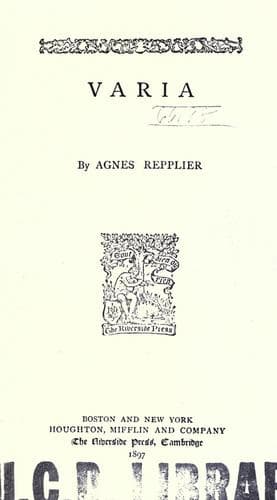
American essays -- 19th century; Literature -- History and criticism
Well, well, the days for such delights are over. We may say what we
please about the rewards of modern novel-writing; but what, after
all, is the cold praise of reviewers compared with this open glory
and exaltation? It is moderately impressive to be told over and
over again by Marie Corelli’s American publishers that the queen of
England thinks “The Soul of Lilith” and “The Sorrows of Satan” are
good novels; but this mere announcement, however reassuring,--and it
is a point on which we require a good deal of reassurance,--does not
thrill us with the enthusiasm we should feel if her Majesty, and the
Prince of Wales, and the Duke of York, and the British public united
in a flattering ovation. The incidents which mark the irresistible and
unwelcome changes forced upon the world by each successive generation
which inhabits it are the incidents we love to read about, and which
are generally considered too insignificant for narration. In a single
page Addison tells us more concerning the frivolous, idle, half torpid,
wholly contented life of an eighteenth-century citizen than we could
learn from a dozen histories. His diaries, meant to be purely satiric,
have now become instructive. They show us, as in a mirror, the early
hours, the scanty ablutions,--“washed hands, but not face,”--the
comfortable eating and drinking, the refreshing absence of books, the
delightful vagueness and uncertainty of foreign news. A man could
interest himself for days in the reported strangling of the Grand
Vizier, when no intrusive cablegram came speeding over the wires to
silence and refute the pleasant voice of rumor.
Public-domain text, read in full here on John Shaqi.
Reviews
Reviews
No reviews yet
Be the first to share your thoughts on this work.
Join the Discussion
Join the discussion
Sign in to leave a comment or review.
Sign InorCreate an account