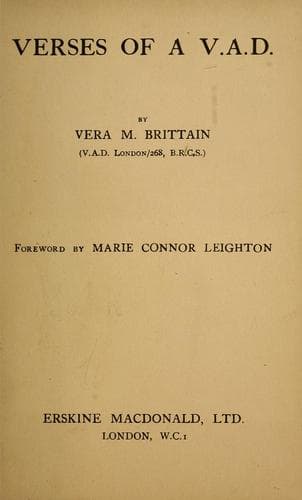
VERSES OF A V.A.D.
VERSES OF A V.A.D
BY
VERA M. BRITTAIN
(V.A.D. LONDON/268, B.R.C.S.)
FOREWORD BY MARIE CONNOR LEIGHTON
ERSKINE MACDONALD, LTD.
LONDON, W.C.1
_All Rights Reserved_
_First published August 1918_
DEDICATED
TO THE MEMORY OF
ROLAND AUBREY LEIGHTON
LIEUTENANT, WORCESTERSHIRE REGIMENT
DIED OF WOUNDS NEAR HÉBUTERNE
DECEMBER 23RD, 1915
“Good-bye, sweet friend. What matters it that you
Have found Love’s death in joy, and I in sorrow?
For hand in hand, just as we used to do,
We two shall live our passionate poem through
On God’s serene to-morrow.”
R. A. L.
FOREWORD
THESE poems, by a writer for whom I have literary hopes, belong very
clearly to that new and vigorous type of poetry which has sprung from
the stress of the last few years and has its root in things done and
suffered rather than in things merely imagined.
Until lately our very belief in the saying that the poet is born and not
made proved that we had completely accepted poetry as coming only from
within, spun, as it were, out of our inner consciousness, and either
quite unhelped, or else only partially helped, by active experiences
from without. We have always understood, of course, that such an
experience as, for instance, the sudden flashing upon us of a magnetic
face as a stranger passes in the street might set aglow a train of
thought that would quicken and melt into feeling, and the feeling would,
in turn, need--and find--expression in poetry.
So far as this we have admitted that outward occurrences in the course
of our quickly flying days can become a source of poetical inspiration.
But, in spite of the pointing finger of Kipling, most of us clung
desperately to the verse that had its sole origin in imaginative emotion
until the blaze of war in the world illumined our souls and showed all
of us that out of our simplest practical work can be struck sparks of
real and great and rare divine fire.
All the poems in this little book are the outcome of things very deeply
felt. It is very difficult for me to write of them because where there
is pain uttered in them, it has almost always been my pain as well as
the author’s. One or two of the sonnets condense the expression of
losses that have meant a life’s upheaval. One or two, again, are
practically a concrete record of simple human things observed and
suffered and of duty strenuously done. Here there is no leisured
dreaming, but sheer experience, solid and stored up, like the honey that
a bee’s labour has stored.
Public-domain text, read in full here on John Shaqi.
Reviews
Reviews
No reviews yet
Be the first to share your thoughts on this work.
Join the Discussion
Join the discussion
Sign in to leave a comment or review.
Sign InorCreate an account