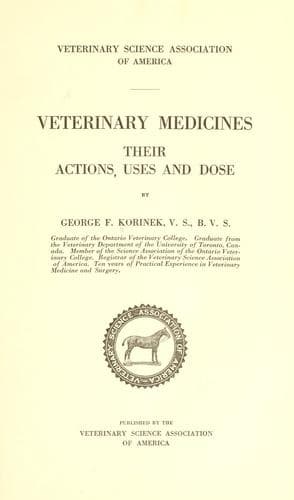
Veterinary Medicines, Their Actions, Uses and DoseKorinek, George Franklyn
Science
Veterinary Medicines, Their Actions, Uses and Dose
Korinek, George Franklyn
Veterinary drugs
PROPERTIES.--A heavy solid, occurring either as an opaque, white powder,
or in irregular masses of two varieties; the one amorphous, transparent
and colorless, like glass; the other crystalline, opaque, and white,
resembling porcelain. Frequently the same piece has an opaque, white
outer crust enclosing the glassy variety. Contact with moist air
gradually changes the glassy into the white opaque variety. Both are
odorless and tasteless. The glassy variety dissolves slowly in thirty
parts of water; the porcelain-like in eighty parts of water. Arcenous
acid is sparingly soluble in alcohol, but soluble in glycerin,
hydrochloric acid and solutions of the alkali hydrates and carbonates.
When heated to 424°, arcenous acid is completely volatilized without
melting.
INCOMPATIBLES.--Lime water, salts of iron and magnesia.
DOSE.--Horses, 1 to 5 grs.; cattle, 2 to 8 grs.; sheep and pigs, 1 to 2
grs.; dogs, ¹⁄₃₀ to ¹⁄₁₀ gr.
LIQUOR POTASSII ARSENITIS--SOLUTION OF POTASSIUM ARSENITE (Fowler’s
Solution)
DERIVATION.--Arcenous acid, potassium bicarbonate, compound tincture of
lavender and distilled water. Strength one part of arcenous acid in 100.
DOSE.--Horses, 2 drs. to 1 oz.; cattle, ¹⁄₂ to 1¹⁄₂ ozs.; sheep and
pigs, 10 to 40 ms.; dogs, 2 to 5 ms. Average dose for horse is ¹⁄₂ oz.
usually given three times daily in drinking water or bran mash.
LIQUOR ACIDI ARSENOSI--SOLUTION OF ARCENOUS ACID
DERIVATION.--Arcenous acid, diluted hydrochloric acid, and distilled
water. Strength one part arcenous acid in 100.
DOSE.--Same as liquor potassii arsenitis.
LIQUOR ARSENI ET HYDRARGYRI IODIDI (Donovan’s Solution)
DERIVATION.--Arcenous iodide, red mercuric iodide, and distilled water,
which should contain not less then one per cent of arcenous iodide and
one per cent of mercuric iodide.
DOSE.--Same as liquor potassii arsenitis.
ACTIONS.--Arsenic and its compounds are gastro-intestinal and pulmonary
tonic, a stimulant and alterative, acting particularly on the digestive
and respiratory mucous membranes and skin. It is antiperiodic and tonic;
also antispasmodic in diseases of the nervous system, and is a nervine
tonic. In large doses it is a corrosive-irritant poison, killing either
by gastro-enteritis, or nervous paresis. Continued doses produce fatty
degeneration. On account of its being a stomachic, small doses promote
the appetite and digestion. Large doses inflame the stomach and derange
digestion. It increases the cardiac action, respiratory power, and
secretion of the intestines. It also stimulates peristalsis. When
tolerance is established, large doses are taken with impunity.
EXTERNALLY.--Arsenic is a very painful escharotic, exciting violent
inflammation. It is a caustic, antiseptic, and parasiticide, and is
frequently used as a sheep dip. It is eliminated chiefly by the kidneys,
skin and saliva and milk of nursing animals.
Public-domain text, read in full here on John Shaqi.
Reviews
Reviews
No reviews yet
Be the first to share your thoughts on this work.
Join the Discussion
Join the discussion
Sign in to leave a comment or review.
Sign InorCreate an account