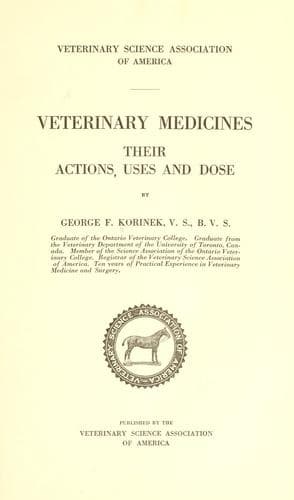
Veterinary Medicines, Their Actions, Uses and DoseKorinek, George Franklyn
Science
Veterinary Medicines, Their Actions, Uses and Dose
Korinek, George Franklyn
Veterinary drugs
In troublesome cases of atonic indigestion in horses respond rapidly
when quinine sulphate is frequently given in thirty to forty grain doses
with half a drachm of dilute nitric or hydrochloric acid. Weak foals and
calves suffering from relaxed condition of the bowels, following a dose
of castor oil are often much benefited by a few doses of cinchona bark,
hydrochloric acid dilute and brandy.
Few medicines are so effectual as cinchona bark or quinine sulphate in
improving appetite and muscular strength and hastening convalescence
from debilitating disease.
They are advantageous in anaemia joined with iron salts.
Good results are obtained from cinchona or quinine in the earlier stages
of tuberculosis, in septicaemia and pyaemia in all animals; in
influenza, protracted cases of strangles, purpura and other similar
diseases of the horse; in septic metritis in cows and ewes and in
lingering cases of distemper in dogs. Their beneficial effects in these
and other diseases probably depending on the action of quinine on
micro-organisms or their products. It is often useful in rheumatism
conjoined with salicylic acid or potassium iodide. Administered with
cathartics, like other bitter tonics, it generally increases their
activity. Alternated with cod liver or olive oil and iron, quinine is
the best tonic for weak dogs and those suffering from chorea.
Quinine and urea hydrochloride has recently come into use as local
anaesthetic. One per cent solutions make a satisfactory substitute for
cocaine, etc. It also has advantages over cocaine. It is non-toxic, it
may be exposed to a boiling temperature and its anaesthetic effect for
dogs after an operation, therefore aiding in dressing of wounds. Its
anaesthetic effect comes on within five minutes to half an hour after
being injected into the intended seat of operation.
Speaking from practical experience, I prefer quinine and urea
hydrochloride to cocaine or any of its allies.
DOSE.--Of the powdered cinchona bark: Horses, 2 dr. to 1 oz.; cattle, 1
to 2 oz.; sheep and pigs, 1 to 4 dr.; dogs, 10 gr. to 1 dr.
ALKALOIDAL SALTS OF CINCHONA--QUININAE SULPHAS--SULPHATE OF QUININE
DOSE.--As a tonic: Horses, 15 gr. to 1 dr.; cattle, ¹⁄₂ to 1¹⁄₂ dr.;
sheep and pigs, 5 to 10 gr.; dogs and cats, 1 to 2 gr. As antipyretic
Dose: Horses and cattle, 2 to 4 dr.; sheep and pigs, 15 gr to 1 dr.;
dogs and cats, 5 to 10 gr.
QUININAE ET UREAE HYDROCHLORIDUM--QUININE AND UREA HYDROCHLORIDE
(NON-OFFICIAL)
Soluble in 18 parts of water. Use hypodermically as a local anesthetic.
COCAINAE HYDROCHLORIDUM--COCAINE HYDROCHLORIDE
“The dried leaves of Erythroxylon Coca Lamarck (Fam. Erythroxylaceae),
known commercially as Huanuco Coca, or of E. Truxillense Rusby, known
commercially as Truxillo Coca, yielding when assayed not less than 0.5
per cent of the ether-soluble alkaloids of coca.” U. S. “The dried
leaves of Erythroxylum Coca, Lam., and its varieties.”
Public-domain text, read in full here on John Shaqi.
Reviews
Reviews
No reviews yet
Be the first to share your thoughts on this work.
Join the Discussion
Join the discussion
Sign in to leave a comment or review.
Sign InorCreate an account