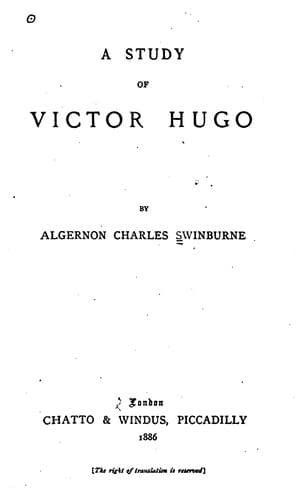
Hugo, Victor, 1802-1885 -- Criticism and interpretation
VICTOR HUGO
BY
ALGERNON CHARLES SWINBURNE
NEW YORK
WORTHINGTON CO., 747 BROADWAY.
1886.
TABLE DES MATIÈRES
THE WORK OF VICTOR HUGO.
_LA LÉGENDE DES SIÈCLES._
THE WORK OF VICTOR HUGO.
In the spring of 1616 the greatest Englishman of all time passed away
with no public homage or notice, and the first tributes paid to his
memory were prefixed to the miserably garbled and inaccurate edition of
his works which was issued seven years later by a brace of players under
the patronage of a brace of peers. In the spring of 1885 the greatest
Frenchman of all time has passed away amid such universal anguish and
passion of regret as never before accompanied the death of the greatest
among poets. The contrast is of course not wholly due to the
incalculable progress of humanity during the two hundred and sixty-nine
years which divide the date of our mourning from the date of
Shakespeare's death: nor even to the vast superiority of Frenchmen to
Englishmen in the quality of generous, just, and reasonable gratitude
for the very highest of all benefits that man can confer on mankind. For
the greatest poet of this century has been more than such a force of
indirect and gradual beneficence as every great writer must needs be.
His spiritual service has been in its inmost essence, in its highest
development, the service of a healer and a comforter, the work of a
redeemer and a prophet. Above all other apostles who have brought us
each the glad tidings of his peculiar gospel, the free gifts of his
special inspiration, has this one deserved to be called by the most
beautiful and tender of all human titles--the son of consolation. His
burning wrath and scorn unquenchable were fed with light and heat from
the inexhaustible dayspring of his love--a fountain of everlasting and
unconsuming fire. We know of no such great poet so good, of no such good
man so great in genius: not though Milton and Shelley, our greatest
lyric singer and our single epic poet, remain with us for signs and
examples of devotion as heroic and self-sacrifice as pure. And therefore
it is but simply reasonable that not those alone should mourn for him
who have been reared and nurtured on the fruits of his creative spirit:
that those also whom he wrought and fought for, but who know him only as
their champion and their friend--they that cannot even read him, but
remember how he labored in their cause, that their children might fare
otherwise than they--should bear no unequal part in the burden of this
infinite and worldwide sorrow.
Public-domain text, read in full here on John Shaqi.
Reviews
Reviews
No reviews yet
Be the first to share your thoughts on this work.
Join the Discussion
Join the discussion
Sign in to leave a comment or review.
Sign InorCreate an account