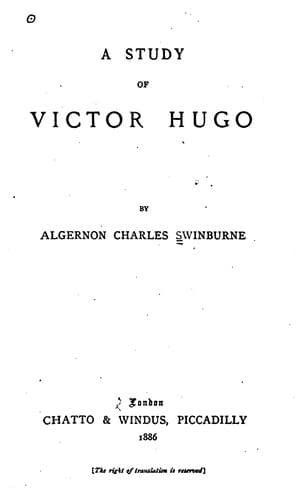
Hugo, Victor, 1802-1885 -- Criticism and interpretation
The subtlety and variety of power displayed in the treatment of the
chief character should be evident alike to those who look only on the
upright side of it and those who can see only its more oblique aspect.
The Cromwell of Hugo is as far from the faultless monster of Carlyle's
creation and adoration as from the all but unredeemed villain of
royalist and Hibernian tradition: he is a great and terrible poetic
figure, imbued throughout with active life and harmonized throughout by
imaginative intuition: a patriot and a tyrant, a dissembler and a
believer, a practical humorist and a national hero.
The famous preface in which the batteries of pseudo classic tradition
were stormed and shattered at a charge has itself long since become a
classic. That the greatest poet was also the greatest prose-writer of
his generation there could no longer be any doubt among men of any
intelligence: but not even yet was more than half the greatness of his
multitudinous force revealed. Two years later, at the age of
twenty-seven, he published the superb and entrancing _Orientales_: the
most musical and many-colored volume of verse that ever had glorified
the language. From _Le Feu du Ciel_ to _Sara la Baigneuse_, from the
thunder-peals of exterminating judgment to the flute-notes of innocent
girlish luxury in the sense of loveliness and life, the inexhaustible
range of his triumph expands and culminates and extends. Shelley has
left us no more exquisite and miraculous piece of lyrical craftsmanship
than _Les Djinns_; none perhaps so rich in variety of modulation, so
perfect in rise and growth and relapse and reiterance of music.
Murs, ville,
Et port,
Asile
De mort,
Mer grise
Où brise
La brise,
Tout dort.
Dans la plaine
Naît un bruit.
C'est l'haleine
De la nuit.
Elle brame
Comme une âme
Qu'une flamme
Toujours suit.
Then the terrible music of the flight of evil spirits--"troupeau lourd
et rapide"--grows as it were note by note and minute by minute up to its
full height of tempest, and again relapses and recedes into the
subsiding whisper of the corresponsive close.
Ce bruit vague
Qui s'endort,
C'est la vague
Sur le bord;
C'est la plainte
Presque éteinte
D'une sainte
Pour un mort.
On doute
La nuit...
J'écoute:--
Tout fuit,
Tout passe;
L'espace
Efface
Le bruit.
And here, like Shelley, was Hugo already the poet of freedom, a champion
of the sacred right and the holy duty of resistance. The husk of a
royalist education, the crust of reactionary misconceptions, had already
begun to drop off; not yet a pure republican, he was now ripe to receive
and to understand the doctrine of human right, the conception of the
common weal, as distinguished from imaginary duties and opposed to
hereditary claims.
Public-domain text, read in full here on John Shaqi.
Reviews
Reviews
No reviews yet
Be the first to share your thoughts on this work.
Join the Discussion
Join the discussion
Sign in to leave a comment or review.
Sign InorCreate an account