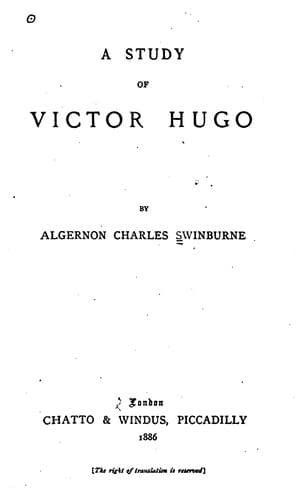
Hugo, Victor, 1802-1885 -- Criticism and interpretation
At every successive stage of his task, the man who undertakes to glance
over this great cycle of poems must needs incessantly call to mind the
most worn and hackneyed of all quotations from its author's works--"J'en
passe, et des meilleurs." There is here no room, as surely there should
nowhere now be any need, to speak at any length of the poems in which
Roland plays the part of protagonist; first as the beardless champion of
a five days' fight, and again as the deliverer whose hand could clear
the world of a hundred human wolves in one continuous sword-sweep. There
is hardly time allowed us for one poor word or two of tribute to such a
crowning flower of song as _La Rose de L'Infante_, with its parable of
the broken Armada made manifest in a wrecked fleet of drifting petals;
to the superb and sonorous chant of the buccaneers, in which all the
noise of lawless battle and stormy laughter passes off into the carol of
mere triumphant love and trust; or even to the whole inner cycle of
mystic and primæval legend which seeks utterance for the human sense of
oppression or neglect by jealous or by joyous gods; for the wild
profound revolt of riotous and trampled nature, the agony and passion
and triumph of invincible humanity, the protest and witness of enduring
earth against the passing shades of heaven, the struggle and the plea of
eternal manhood against all transient forces of ephemeral and tyrannous
godhead. Within the orbit of this epicycle one poem only of the first
part, a star of strife and struggle, can properly be said to revolve;
but the light of that planet has fire enough to animate with its reflex
the whole concourse of stormy stars which illuminate the world-wide
wrestle of the giants with the gods. The torch of revolt borne by the
transfigured satyr, eyed like a god and footed like a beast, kindles the
lamp of hopeful and laborious rebellion which dazzles us in the eye of
the Titan who has seen beyond the world. In the song that struck silence
through the triumph of amazed Olympus there is a sound and air as of the
sea or the Book of Job. There may be something of Persian or Indian
mysticism, there is more of universal and imaginative reason, in the
great allegoric myth which sets forth here how the half-brute child of
one poor planet has in him the seed, the atom, the principle of life
everlasting, and dilates in force of it to the very type and likeness of
the eternal universal substance which is spirit or matter of life; and
before the face of his transfiguration the omnipresent and omnipotent
gods who take each their turn to shine and thunder are all but shadows
that pass away. Since the Lord answered Job out of the whirlwind no ear
has heard the burst of such a song; but this time it is the world that
answers out of its darkness the lords and gods of creed and oracle, who
have mastered and have not made it. And in the cry of its protest and
the prophecy of its advance there is a storm of swelling music which is
Public-domain text, read in full here on John Shaqi.
Reviews
Reviews
No reviews yet
Be the first to share your thoughts on this work.
Join the Discussion
Join the discussion
Sign in to leave a comment or review.
Sign InorCreate an account