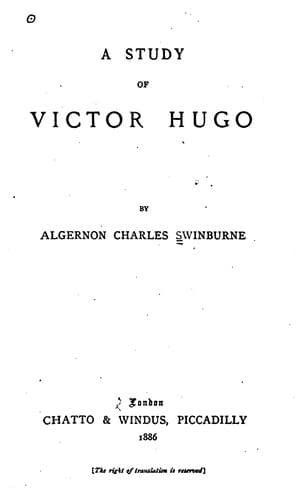
Hugo, Victor, 1802-1885 -- Criticism and interpretation
And this wind "bloweth where it listeth": now it comes to us charged
with all the heart of all the roses in the world; its breath when it
blows towards Greece has in it a murmur as of Shelley's _Epipsychidion_;
the caress of its love-making has all the freedom and all the purity of
Blake's; now it passes by us in darkness, from depth to depth of the
bitter mystery of night. A vision of ruined worlds, the floating
purgatorial prisons of ruined souls, adrift as hulks on the sea of
darkness everlasting, shows us the harvest in eternity of such seed as
was sown in time by the hands of such guides and rulers of men as we
hear elsewhere speaking softly with each other in the shadows, within
hail of the confessional and the scaffold. The loftiest words of counsel
sound sweeter in the speech of this great spirit than the warmest
whispers of pleasure; and again, the heaviest stroke of damning satire
is succeeded by the tenderest touch of a compassion that would leave not
a bird in captivity. The hand that opens the cage-door is the same which
has just turned the key on the braggart swordsman, neither "victorious"
nor "dead," but condemned to everlasting prison behind the bars of iron
verse.
But the two long poems which dominate the book, like two twin summits
clothed round with fiery cloud and crowned with stormy sunshine, tower
equal in height and mass of structure with the stateliest in the two
parts preceding. The voice that rolls throughout _Les Quatre Jours
d'Elciis_ the thunder of its burning words reawakens and prolongs the
echo of Félibien's pity and wrath over the murdered corpse of a child
unborn; we recognize in the speaker a kinsman of Welf's, the
unconquerable old castellan of Osbor, delivered only by an act of
charity into the treacherous hands of the princes whom his citadel had
so long defied. Of Elciis, as of him, the poet might have said--
Si la mer prononçait des noms dans ses marées,
Ô vieillard, ce serait des noms comme le tien.
Such names will no doubt provoke the soft superior smile of a culture
too refined for any sort of enthusiasm but the elegant ecstasy of
self-worship; and such simplicity will excite, on the other hand, a
deep-mouthed bray of scorn from the whole school or church whose apostle
in France was St. Joseph de Maistre, in England St. Thomas Coprostom,
late of Craigenputtock and Chelsea; the literary lappers of imaginary
blood, the inkhorn swordsmen and spokesmen of immaterial iron. The rage
of their contempt for such as Hugo, the loathing of their scorn for such
as Shelley, ought long since to have abashed the believers in principles
which find no abler defenders or more effective champions than these.
Public-domain text, read in full here on John Shaqi.
Reviews
Reviews
No reviews yet
Be the first to share your thoughts on this work.
Elsewhere in the archive
Join the Discussion
Join the discussion
Sign in to leave a comment or review.
Sign InorCreate an account