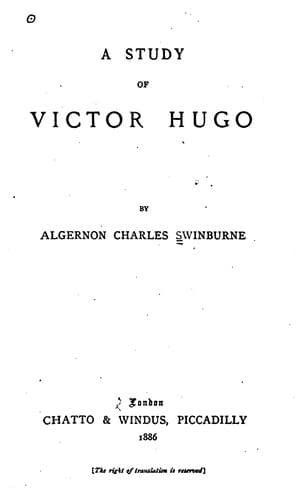
Hugo, Victor, 1802-1885 -- Criticism and interpretation
For it is true that the main truths preached and enforced and insisted
on by such fanatical rhetoricians as Milton, as Mazzini, or as Hugo, are
as old as the very notion of right and wrong, as the rudest and crudest
conception of truth itself; and it is undeniable that the Gospel
according to St. Coprostom has the invaluable merit of pungent
eccentricity and comparatively novel paradox. The evangelist of "golden
silence"--whose own speech, it may be admitted, was "quite other" than
"silvern"--is logically justified in his blatant but ineffable contempt
for the dull old doctrines of mere mercy and righteousness, of liberty
that knows no higher law than duty, of duty that depends for its
existence on the existence of liberty. Such a creed, in the phrase of a
brother philosopher whose "reminiscences" may be gathered from
Shakespeare, and whose views of his contemporaries were identical in
tone and expression with the opinions of Mr. Carlyle on his, was mouldy
before our grandsires had nails on their toes. It is far more
intelligent, more original, more ingenious than all the old cant and
rant against priests and kings and vow-breakers and blood-spillers, to
discover the soul of goodness in Ratbert the Second or Napoleon the
Third, and observingly distill it out into analytic and mono-dramatic
blank verse. And it will never be said that this reaction against the
puerile or senile preference of right to wrong and principle to
prosperity has not been carried far enough in our time. Carlyle, the man
of brass, and Musset, the man of clay, as far apart on all other points
as two writers of genius could well be, have shown themselves at one in
high-souled scorn for "principles of mere rebellion" such as Landor's
and Milton's, or for such "belief in a new Brutus" as might disturb the
dream of Augustulus. But, even as an old paradox becomes with time a
commonplace, so does an old commonplace become in its turn a paradox;
and a generation whose poets and historians have long blown the trumpet
before the legitimacy of Romanoffs or the bastardy of Bonapartes may
properly be startled and scandalized at the childish eccentricity of an
old-world idealist who maintains his obsolete and preposterous belief
that massacre is murder, that robbery is theft, and that perjury is
treason. No newer doctrine, no sounder philosophy, no riper wisdom than
this, can be gathered from the declamations of those idle old men--as
Goneril, for example, would have called them--who speak this poet's
mind again and again in verse which has no more variety of splendor or
magnificence of music than the sea.
Hélas, on voit encor les astres se lever,
L'aube sur l'Apennin jeter sa clarté douce,
L'oiseau faire son nid avec des brins de mousse,
La mer battre les rocs dans ses flux et reflux,
Mais la grandeur des cœurs c'est ce qu'on ne voit plus.
There is nothing ingenious in that; it is no better, intellectually
considered, than a passage of Homer or Isaiah.
Public-domain text, read in full here on John Shaqi.
Reviews
Reviews
No reviews yet
Be the first to share your thoughts on this work.
Elsewhere in the archive
Join the Discussion
Join the discussion
Sign in to leave a comment or review.
Sign InorCreate an account