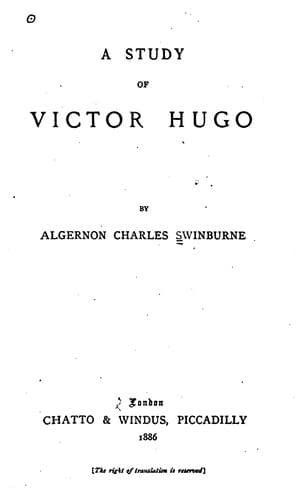
Hugo, Victor, 1802-1885 -- Criticism and interpretation
But though every verse has the ring of tested gold, and every touch
gives notice of the master's hand, yet the glory even of these _Four
Days_ is eclipsed by the _Vision of Dante._ Far apart and opposite as
they stand in all matters of poetic style and method--Dante writing with
the rigid and reserved concision of a Tacitus, Hugo with the rushing yet
harmonious profusion of a Pindar--the later master is the only modern
poet who could undertake without absurdity or presumption to put words
worthy of Dante into Dante's mouth. The brazen clatter of Byron's
_Prophecy_ was not redeemed or brought into tune by the noble energy and
sound insight of the political sympathies expressed in the accent of a
stump-orator to the tune of a barrel-organ. But a verse of Hugo's falls
often as solid and weighty and sure, as full in significance of perfect
and pregnant sound, as even a verse of Alighieri's. He therefore, but he
alone, had the power and the right to call up the spirit of Dante now
thirty years ago, and bid it behold all the horrors of Europe in 1853;
the Europe of Haynau and Radetzky, of Nicholas the First and Napoleon
the last. Any great modern poet's notion of an everlasting hell must of
course be less merely material than Dante's mechanism of hot and cold
circles, fire and ice, ordure and mire; but here is the same absolute
and equitable assent to justice, the same fierce and ardent fidelity to
conscience, the same, logic and the same loyalty as his.
Ô sentence! ô peine sans refuge!
Tomber dans le silence et la brume à jamais!
D'abord quelque clarté des lumineux sommets
Vous laisse distinguer vos mains désespérées.
On tombe, on voit passer des formes effarées,
Bouches ouvertes, fronts ruisselants de sueur,
Des visages hideux qu'éclaire une lueur.
Puis on ne voit plus rien. Tout s'efface et recule.
La nuit morne succède au sombre crépuscule.
On tombe. On n'est pas seul dans ces limbes d'en bas;
On sent frissonner ceux qu'on ne distingue pas;
On ne sait si ce sont des hydres ou des hommes;
On se sent devenir les larves que nous sommes;
On entrevoit l'horreur des lieux inaperçus,
Et l'abîme au-dessous, et l'abîme au-dessus.
Puis tout est vide! on est le grain que le vent sème.
On n'entend pas le cri qu'on à poussé soi-même;
On sent les profondeurs qui s'emparent de vous;
Les mains ne peuvent plus atteindre les genoux;
On lève au ciel les yeux et l'on voit l'ombre horrible;
On est dans l'impalpable, on est dans l'invisible;
Des souffles par moments passent dans cette nuit.
Puis on ne sent plus rien.--Pas un vent, pas un bruit,
Pas un souffle; la mort, la nuit; nulle rencontre;
Rien pas même une chute affreuse ne se montre
Et l'on songe à la vie, au soleil, aux amours,
Et l'on pense toujours, et l'on tombe toujours!
The resurrection of the victims to give evidence at the summons of the
archangel--a heavy cloud of witnesses,
Triste, livide, énorme, ayant un air de rage--
Public-domain text, read in full here on John Shaqi.
Reviews
Reviews
No reviews yet
Be the first to share your thoughts on this work.
Elsewhere in the archive
Join the Discussion
Join the discussion
Sign in to leave a comment or review.
Sign InorCreate an account