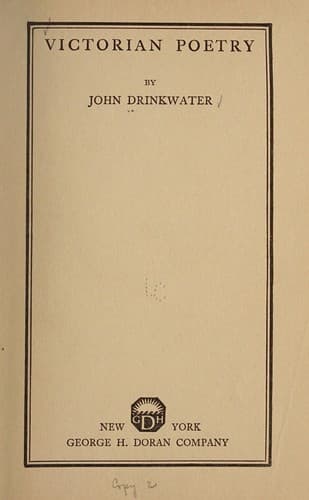
English poetry -- 19th century -- History and criticism; Great Britain -- History -- Victoria, 1837-1901
In the succeeding age, from the Elizabethans to the Augustans, the same
principle may be discovered in the practice of poets as different in
their personal quality as, say, Donne, Milton and Lovelace. Donne’s--
By Absence this good means I gain
That I can catch her
Where none can watch her,
In some close corner of my brain:
There I embrace and kiss her
And so enjoy her and none miss her....
may have perplexed his readers by its intellectual turn, but it cannot
have seemed anything but easily natural to them in its actual word. If
Donne was startling, it was in what he said and not at all in his way
of saying it. And so with Milton. Common speech could never put on a
sublimer transfiguration than in such passages as--
Weep no more, woful Shepherds, weep no more,
For Lycidas your sorrow is not dead,
Sunk though he be beneath the watry floar,
So sinks the day-star in the ocean bed,
And yet anon repairs his drooping head,
And tricks his beams, and with new-spangled Ore
Flames in the forehead of the morning sky....
But it remains the common speech that is being so dignified. Milton’s
diction, more eminently poetical perhaps than any other in the
language, is still founded on the grave, full-syllabled Biblical idiom
that we are sure was current in the ordinary enlightened speech of the
time. The first readers of his poems would find a familiar tongue,
however unsuspected was the beauty that it revealed to them. And in the
lighter lyrists of that age, this relation of poetic to common speech,
secured without any apparent deliberation--we may indeed say definitely
without it--and yet achieving the magic with easy certainty, shines
round us on every hand.
Tell me not, Sweet, I am unkind
That from the nunnery
Of thy chaste breast and quiet mind
To war and arms I fly ...
and--
Shut not so soon; the dull-eyed night
Has not as yet begun
To make a seizure on the light,
Or to seal up the sun ...
and--
Out upon it! I have lov’d
Three whole days together;
And am like to love three more,
If it prove fair weather ...
are all alike loyal both to poetry and to the common English of their
time. Nor do the lyrists whose raptures were less of the world go
elsewhere for their means of expression. Vaughan, with--
Happy those early days, when I
Shined in my Angel-infancy!
Before I understood this place
Appointed for my second race,
Or taught my soul to fancy aught
But a white, celestial thought....
and Herbert with--
Sweet day, so cool, so calm, so bright,
The bridal of the earth and sky--
The dew shall weep thy fall to-night
For thou must die....
and Crashaw with--
Since ’tis not to be had at home
She’ll travel for a martyrdom....
follow the same poetic instinct precisely.
Public-domain text, read in full here on John Shaqi.
Reviews
Reviews
No reviews yet
Be the first to share your thoughts on this work.
Join the Discussion
Join the discussion
Sign in to leave a comment or review.
Sign InorCreate an account