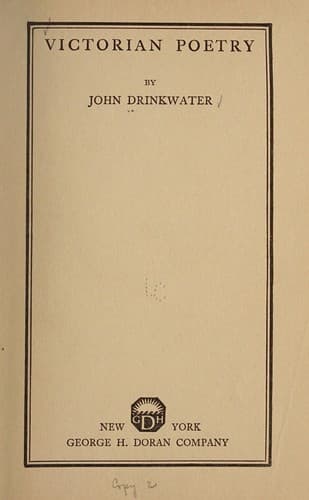
English poetry -- 19th century -- History and criticism; Great Britain -- History -- Victoria, 1837-1901
This, then, is the first value that we discover in Shakespeare’s use in
that connection of the word “sessions”--an exact functioning of the
poetic imagination. But over and above that there is yet another value,
one that is not very easy to define in set terms, and one of which
Shakespeare himself can hardly have been consciously aware. “Sessions,”
as we now read the word, calls to our mind, as it did to his, a court
of law with all its weighty circumstance; also, as we read it in the
sonnet, we get precisely the effect of pure imaginative effort that
Shakespeare got, or as much of it as is possible to our own faculty;
but the word has also taken on a strange atmospheric significance,
almost a shade of actual meaning that is beyond its original intention.
In its strictly imaginative value alone, the word was one that might
without offence have been more or less similarly used by one of
Shakespeare’s contemporaries or early successors, even after his
brilliant discovery of it in that context. Shakespeare’s choice of the
word was entirely admirable for his imaginative purpose, but it was not
so astonishing as to make it explicitly his own beyond the use of any
other poet who wished to escape the charge of mere theft. But as time
went on, the word, fixed there in its sonnet, underwent a spiritual
evolution, that for practical purposes was complete in any case by the
time Tennyson arrived, until it was in some sense of a newly acquired
nature, and no longer safe for any poet’s handling. The word could not
now be used in anything approaching the same context without calling
up in the reader’s mind the whole dark and passionate background of
Shakespeare’s sonnets. It has, in short, acquired a specifically
literary association which is to say--although some critics would
seem to overlook the fact--that it is the living witness of one of
the supreme moments of human experience, but also that it has become
so essential a part of that particular moment that it is now almost
impossible to use it in the service of any other. And when Tennyson
began to write he found a language that was strewn with words that had
put on this dangerous nature, beautiful and often as it would appear
irreplaceable words, yet now with calamity in their touch for the poet.
To reject them was by no means the same thing as rejecting the false
“poetic” inflation that had been the mark of Wordsworth’s attack. It
meant that by now a new discipline of a very arduous and vigilant kind
had become necessary in the practice of poetry. On every hand were
admirable and seductive instruments the use of which was forbidden. If
you were Keats you might privateer among the old poetry with profit,
but his success in this matter was the adventure of lucky genius, not
an example to be followed. Shakespeare could write
Not poppy nor mandragora
Nor all the drowsy syrups of this world ...
and Keats could find his Autumn sleeping
Drowsed with the fume of poppies ...
Public-domain text, read in full here on John Shaqi.
Reviews
Reviews
No reviews yet
Be the first to share your thoughts on this work.
Join the Discussion
Join the discussion
Sign in to leave a comment or review.
Sign InorCreate an account