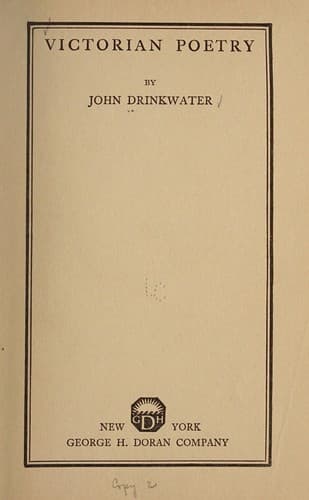
English poetry -- 19th century -- History and criticism; Great Britain -- History -- Victoria, 1837-1901
Finally, Tennyson found a language that as a literary vehicle was
nearly five hundred years old, three hundred at least of which had
been of rich and unceasing activity. This fact presented a difficulty
distinct from that which has been examined in connection with
Shakespeare’s use of the word “sessions.” Not only had particular words
acquired a specific associative value which made them dangerous for use
again in poetry, but the whole construction of a poetic phrase was now
beset by mazes of seductive suggestion, word calling up word in long
sequence from the vast stores of poetry that had been accumulated by
the race. It was no longer a very easy thing to see the object before
you, precisely in its immediate appearance, wholly dissociated from any
company that it might have kept in some earlier creative presentation.
It needed something of a conscious effort in looking at yellow sands
to remind yourself that coral was not necessarily somewhere about, to
remember that an albatross was not positively doomed to meet its death
from a cross-bow, to hear the nightingale without hearing also the
undertones of “tears amid the alien corn,” to see a country graveyard
wholly unshadowed by the ghosts of village Hampdens and mute inglorious
Miltons. There was no simple way of escape for the poet from this
storied experience of his ancestry. He had to face it courageously
like the rest of experience, to assimilate and master it, and in so
far as it passed into his work at all, as it was bound to do in some
measure, to stamp it with his own pressure and so recreate it. But it
did complicate his task. We may now see how Tennyson dealt with this
and the other problems that have been presented.
Chapter IV
_Tennyson’s Diction_
In connection with his diction it will be convenient at first to
consider a single poem of Tennyson’s, which embodies most of the
characteristics of his style--this from _In Memoriam_--
Calm is the morn without a sound,
Calm as to suit a calmer grief,
And only thro’ the faded leaf
The chestnut pattering to the ground:
Calm and deep peace on this high wold,
And on these dews that drench the furze
And all the silvery gossamers
That twinkle into green and gold:
Calm and still light on yon great plain
That sweeps with all its autumn bowers,
And crowded farms and lessening towers,
To mingle with the bounding main:
Calm and deep peace in this wide air,
These leaves that redden to the fall;
And in my heart, if calm at all,
If any calm, a calm despair;
Calm on the seas, and silver sleep,
And waves that sway themselves in rest,
And dead calm in that noble breast
Which heaves but with the heaving deep.
Public-domain text, read in full here on John Shaqi.
Reviews
Reviews
No reviews yet
Be the first to share your thoughts on this work.
Join the Discussion
Join the discussion
Sign in to leave a comment or review.
Sign InorCreate an account