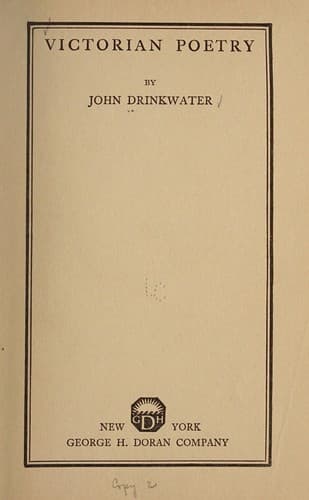
English poetry -- 19th century -- History and criticism; Great Britain -- History -- Victoria, 1837-1901
But--shop each day and all day long!
Friend, your good angel slept, your star
Suffered eclipse, fate did you wrong!
For where these sorts of treasures are
There should our hearts be--Christ, how far!
Here we have the romantic richness, the direct conversational
idiom, and the crabbed Hobbs-Nobbs figure all in one. And this
last in Browning’s work was, I think, a further development of his
dissatisfaction with the habit of verse as he found it in general use.
If the “elevated” manner seemed to him to be exhausted, the colloquial
manner that he adopted as an alternative may very well soon have
seemed to him to be too flat and commonplace, to lack the spring of
good poetic writing, and it was a natural thing for his genius to
enliven it not by a return to the accepted manner only--though he did
this as well--but also by inventing a new complex of the common idiom,
fantastic, involved, and striking, if sometimes only by its oddity,
yet always alert and personal. “I want to know a butcher paints”
is the idiom of ordinary speech lifted bodily into poetry with the
slightest of sea-changes; “O lyric love” is the same idiom ennobled and
intensified, transfigured in the traditional way by a poetic master;
in Nokes and Stokes and their azure feats is again the same idiom, but
now vexed into an attitude, not in the least insincerely, but by a poet
who has bravely but wilfully cut the old moorings and finds new ones
very far to seek. Nothing could be less just than to accuse Browning
of deliberate antics, but if, even for the most disinterested reasons,
you forsake solid earth for the tight-rope you cannot help performing
with the pole, and you are lucky if you get across even at that, which
it must be allowed Browning generally did. I said that the stanzas
from _Shop_ showed the three strains in his style satisfactorily
blended, but it would perhaps be nearer to the truth to say that they
show them in close association, each contributing to a satisfactory
whole, and kept by Browning’s art from striking any discord, shown by
him, in short, equally to be natural and congruous elements in the
unity of his style. As showing these elements more indistinguishably
combined worked into one texture, three stanzas may be given from _A
Toccata of Galuppi’s_--
Did young people take their pleasure when the sea was warm in May?
Balls and masks begun at midnight, burning ever to mid-day
When they made up fresh adventures for the morrow do you say?
Was a lady such a lady, cheeks so round and lips so red,--
On her neck the small face buoyant, like a bell-flower on its bed,
O’er the breasts superb abundance where a man might base his head?
Well (and it was graceful of them), they’d break talk off and afford
--She, to bite her mask’s black velvet, he, to finger on his sword,
While you sat and play’d Toccatas, stately at the clavichord?
Public-domain text, read in full here on John Shaqi.
Reviews
Reviews
No reviews yet
Be the first to share your thoughts on this work.
Join the Discussion
Join the discussion
Sign in to leave a comment or review.
Sign InorCreate an account