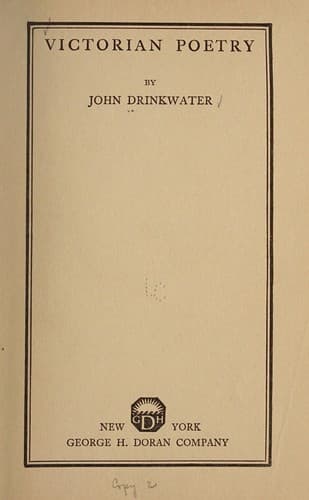
English poetry -- 19th century -- History and criticism; Great Britain -- History -- Victoria, 1837-1901
passion, a poetical technician familiar with every classic example and
at the same time liberal in experiment; and just such a poet in his
own measure was Matthew Arnold. Herrick, on the other hand, for all
his parsonage, was the lyrist of fleeting beauty, of ghosts in the
blossoming meadows, of exquisite and poignant moments, with no gospel
but that with beauty loved comes beauty lost, a poet who used simple
and established measures with perfect mastery and little questioning.
And so again on his own scale such a poet was Swinburne. And yet in
some essential respect Milton is of a kind with Herrick and Arnold of
a kind with Swinburne far more clearly than is Milton with Arnold or
Herrick with Swinburne. When the question of personal quality has been
finally considered Milton and Herrick remain of the seventeenth century
and Arnold and Swinburne of the nineteenth. The purpose of the present
essay is to ascertain as far as possible what it is that distinguishes
what we call the Victorian age in English poetry from the great ages
that preceded it. In order to do this it will be necessary to consider
the personal quality in several poets, but this will be done rather
to discover the common spirit than to present a series of individual
studies.
Chapter II
_Diction in English Poetry_
Queen Victoria came to the throne in 1837. The date is not an
inconvenient one to set at the beginning of a study of the poetry of
the age to which she gave her name. Shelley, Byron, and Keats were
dead, Wordsworth’s most important work was finished, Alfred Tennyson,
Robert Browning, and Elizabeth Barrett had made their first appearances
in print, Matthew Arnold was at school, Dante Gabriel Rossetti and
his sister Christina were children, William Morris and Algernon
Charles Swinburne had just been born. Walter Savage Landor, one of
the strangest figures in our poetical literature, whose first poems
had been published in 1795, was still at the prime of his genius, but
the small body of his best work does not mark him very definitely as
either Romantic or Victorian. There were a number of less famous but by
no means inconsiderable poets whose work will call for notice as we
proceed.
Public-domain text, read in full here on John Shaqi.
Reviews
Reviews
No reviews yet
Be the first to share your thoughts on this work.
Join the Discussion
Join the discussion
Sign in to leave a comment or review.
Sign InorCreate an account