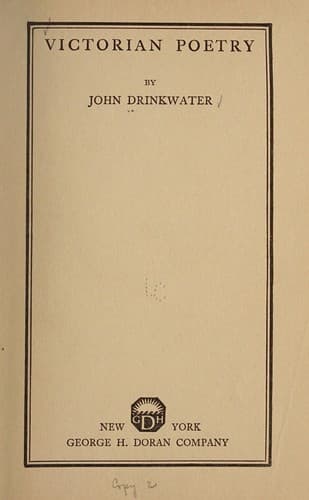
English poetry -- 19th century -- History and criticism; Great Britain -- History -- Victoria, 1837-1901
This does not often happen to a poet, and, while we may be glad that
now and again the old office of poetry in the daily counsels of the
people should be renewed, it is well that in the general run of things
this should be so. Nothing is more likely to turn a poet’s head than
to be accepted as an oracle, and it must be allowed that it turned
Tennyson’s head a little. His was too fine a nature for the effects to
be very serious, and Mr. Nicolson is inclined to overstate the case
when he talks of Tennyson’s acumen in trimming his sails to every
fresh wind. The truth is that the business of poetry and of ordered
philosophy are distinct things, and while many of us think that in the
end poetry has the more persuasive voice of the two, as she certainly
has the more charming, it is not very good for her to be nattered
into the belief that she can use both at will. And Tennyson was so
flattered. The moral judgment, the function of which in Shakespeare’s
art, and Milton’s and Wordsworth’s, we have discussed, became with
Tennyson as independent a preoccupation as it had been with Pope, but
with Tennyson it was at once much more serious and much more sincere
and less witty in nature, and, in its divorcement from poetry, much
more dangerous in consequence of this. This is by no means to say
that Tennyson’s moral pieces are never good poetry or that they are
not very often durably convincing in their morality, but it is to say
that he would often impose upon his poetry a moral judgment that was
not a passionate one like Milton’s or a sententiously dialectical
one like Pope’s, but an almost official one held with all the
solemnity of official responsibility, and gathered as much from the
abstract public opinion to which he in turn ministered as from his
own brooding conviction. To say that Tennyson was dishonest in this
is to say something that should not be said about so rare a poet and
so single-hearted a man. It is not even as though the moral judgment
to which he committed himself was ever one of which he could not
quite sincerely say that he approved, and in further extenuation it
must be remembered that, after all the talk about the waste tissue in
Tennyson’s work which came from his concern in this way with ephemeral
moods and institutions, there is on actual examination very little of
his poetry which makes wholly unprofitable reading to-day. But the
trouble so far as it went was, it may be, that Tennyson was tempted
into confusing moral opinions about particular things with a presiding
moral judgment and to introduce these into a poetical context where
they had no proper place. Milton’s moral nature could assert itself
over and above his poetical creation, and in so far as that was so he
could be said to indulge a moral point of view in a way that made his
sense of artistic fitness a little less fine than Shakespeare’s. But
Tennyson went beyond this, and not only allowed moral points of view
Public-domain text, read in full here on John Shaqi.
Reviews
Reviews
No reviews yet
Be the first to share your thoughts on this work.
Elsewhere in the archive
Join the Discussion
Join the discussion
Sign in to leave a comment or review.
Sign InorCreate an account