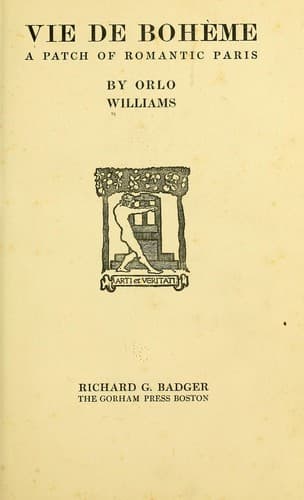
Vie de Bohème: A Patch of Romantic ParisWilliams, Orlo
History
Vie de Bohème: A Patch of Romantic Paris
Williams, Orlo
Paris (France) -- Intellectual life; Paris (France) -- Social life and customs
guessed the intoxication of the air which a Roger de Beauvoir delicately
breathed, when Paris, her spirit newly quickened with the exhilaration
of a potent elixir, was yet unspoiled by modern cosmopolitan vulgarity,
and her inner soul shone out, through all her deformities and
incongruities, with a gay and unmasked confidence.
She did not shine before an unseeing generation, for the Parisians of
the Romantic age adored their city, dandies, Bohemians, and _bourgeois_
alike, all passionately conscious of their privileged citizenship,
though they could admit with Maxime du Camp that under Louis Philippe
she was "one of the dirtiest, the most tortuous, and the most unhealthy"
in the world. As they lived in her, so they wrote of her--with pride.
Victor Hugo did her great homage in "Notre Dame de Paris" and "Les
Misérables," Eugène Sue in "Les Mystères de Paris," and Paul de Kock in
all his work, but these achievements appear as slight and partial
sketches beside the wonderful and penetrating picture which Balzac drew
of Paris--at once the background and the protagonist--in his greatest
novels. Balzac, besides giving us a world, gave us a great city. Minute
as were the studies he made of the provinces, they are nothing to the
picture that he drew of the city which he regarded as the brain of the
whole world, the leader of its civilization. He gloated over Paris as a
scientist gloats over an interesting organism that he has first observed
and then skilfully dissected. He had dissected Paris even on the
threshold of his career. In some of his early stories, like a brilliant
young surgeon fresh from his researches, he overweights the matter in
hand with the results of the laboratory. "Ferragus" begins with a long
comparison of the streets of Paris; "La Fille aux Yeux d'Or" with a
marvellous tirade on the restless race for money and pleasure that is
run by all classes, a tirade which, probing as it does all the strata of
society, is an epitome, in some sort, of all his work. Paris, that small
_enceinte_ which was enclosed within what is now the second line of
_boulevards_, still innocent of the reforming hand of Haussmann,
becoming rich, but hardly yet industrial, not yet the pleasure-ground
of all the world, destitute of railways, squalid, ill-kept, nevertheless
was transformed by his wonderful imagination into the type of all great
cities, which will ever remain true. To him she was "le plus délicieux
des monstres," as he says in "Ferragus." "Mais, ô Paris," he cries, "qui
n'a pas admiré tes sombres paysages, tes échappées de lumière, tes
culs-de-sac profonds et silencieux; qui n'a pas entendu tes murmures,
entre minuit et deux heures du matin, ne connaît encore rien de ta vraie
poésie, ni de tes bizarres et larges contrastes. Il est un petit nombre
de gens ... qui dégustent leur Paris.... Pour ceux-là Paris est triste
ou gai, laid ou beau, vivant ou mort; pour eux Paris est une créature;
Public-domain text, read in full here on John Shaqi.
Reviews
Reviews
No reviews yet
Be the first to share your thoughts on this work.
Elsewhere in the archive
Join the Discussion
Join the discussion
Sign in to leave a comment or review.
Sign InorCreate an account