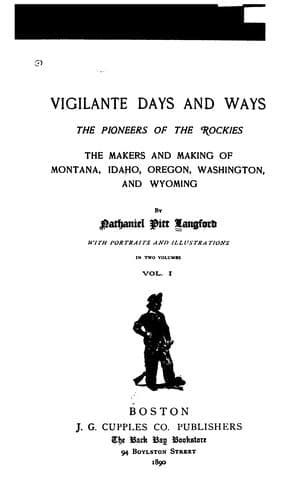
Vigilante Days and Ways: The pioneers of the Rockies; the makers and making of Montana and IdahoLangford, Nathaniel Pitt
History
Vigilante Days and Ways: The pioneers of the Rockies; the makers and making of Montana and Idaho
Langford, Nathaniel Pitt
Frontier and pioneer life -- Northwestern States; Northwestern States -- History; Vigilance committees; West (U.S.) -- History
Circumstances soon occurred which enabled Charley, without disputation,
to assume the role of chief of the Walla Walla desperadoes. Cherokee
Bob, heretofore mentioned as an associate of Plummer at Lewiston, was an
uneducated Southerner. His mother was a half-blood Cherokee,—hence his
name. With a hatred of the North and the Northern soldiery born of
prejudice and ignorance, and a constitutional faith in the superior
prowess of the Southern people, and with mercurial passions inflamed by
the contest that was still raging, this ruffian was nearly a maniac in
his adherence to the cause of Secession. He could talk or think of
little else than the great inferiority of the Northern to the Southern
soldiers, and was continually boasting of his own superior physical
power. He would often taunt the soldiers of the garrison near Walla
Walla. In ingenuity of vaunting expression, he far excelled Captain
Bobadil himself;—but like that hero of dramatic fiction he was destined
to experience a reverse more humiliating, if possible, than that of his
great prototype. With shotgun in hand and revolver in his belt, it was
his frequent boast that he could take a negro along with him, carrying
two baskets loaded with pistols, and put to flight the bravest regiment
of the Federal army.
No person who has witnessed a theatrical performance in a mining camp
can forget the general din and noise with which the audience fill up the
intervals between the acts. Whistling, singing, hooting, yelling, and a
general shuffling of feet and moving about are so invariable as to form,
in fact, a feature of the performance. So long as they are unaccompanied
by quarrelsome demonstrations, and do not become too boisterous, efforts
are seldom made to suppress them. The boys are permitted to have a good
time in their own way, and the lookers-on, accustomed to the scene, are
often compensated for any annoyance that may be occasioned, by strokes
of border humor more enjoyable than the play itself.
Public-domain text, read in full here on John Shaqi.
Reviews
Reviews
No reviews yet
Be the first to share your thoughts on this work.
Join the Discussion
Join the discussion
Sign in to leave a comment or review.
Sign InorCreate an account