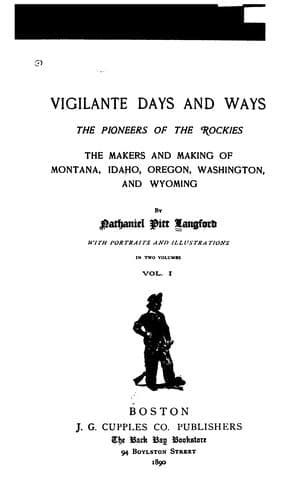
Vigilante Days and Ways: The pioneers of the Rockies; the makers and making of Montana and Idaho — John Shaqi
Vigilante Days and Ways: The pioneers of the Rockies; the makers and making of Montana and IdahoLangford, Nathaniel Pitt
History
Vigilante Days and Ways: The pioneers of the Rockies; the makers and making of Montana and Idaho
Langford, Nathaniel Pitt
Frontier and pioneer life -- Northwestern States; Northwestern States -- History; Vigilance committees; West (U.S.) -- History
A ride of several days brought them to the
Grand Ronde River. During that time they had become sufficiently
acquainted with each other to banish all those feelings of distrust
natural among strangers in a new country. Helm, who to his criminal
qualities added the usual concomitant of being a loud-mouthed braggart,
while narrating his exploits said in a boastful tone to McGranigan:
“Many’s the poor devil I’ve killed, at one time or another,—and the time
has been that I’ve been obliged to feed on some of ’em.”
“Yes,” replied McGranigan, casting a sinister glance at Groves, “and
we’ll have more of that feasting yet.”
The cold sincerity with which these words were uttered struck a chill to
the heart of Groves, which experienced no relief when a few moments
afterwards Helm proposed a plan for organizing a band of Snake Indians,
and returning with them on a predatory excursion against the Walla
Wallas.
“The Walla Wallas,” said he, “own about four thousand horses. With such
a band of Snakes as we can easily organize for the enterprise, we can
run off two thousand of the best of those animals, and after dividing
with the Indians, take ours to Salt Lake and dispose of them to
advantage.”
Groves, who had heard enough to satisfy him that a longer stay with this
company would be accompanied by risks for which he had neither
inclination nor fitness, mounted his horse at a late hour that night,
and spurred back to the Dalles as rapidly as possible. On his arrival he
sent intelligence to the chief of the Walla Wallas of Helm’s
contemplated foray, warning them to keep a careful watch upon their
horses. His plans being frustrated, Helm remained in the vicinity till
Autumn, when, in company with his five companions, he continued his
journey to Camp Floyd. Five hundred miles of this route lay through a
wilderness of mountains, unmarked by a trail and filled with hostile
Indians. It was late in October when the party left Grand Ronde River.
The mountains were covered with snow. Cold weather had set in for a
season whose only changes for the next six months would be a steady
increase of severities. The thermometer, seldom above, often marked a
temperature thirty or forty degrees below zero in the mountains. The
passes were snowed up to the depths of twenty and thirty feet. Wild
game, however abundant in Summer, had retreated to the forests and
fastnesses for food and shelter. Snow-storms and sharp winds were
blinding and incessant. Deep ravines, lofty mountains, beetling crags,
and dismal cañons, alternated with impenetrable pine forests,
inaccessible lava beds, and impassable torrents, encumbered every inch
of the way. Death on the scaffold or escape through this terrible
labyrinth gave the alternative small advantage of the penalty. Small as
it was, Helm and his companions took the risk and plunged into the
mountain wilderness. He alone escaped.
Public-domain text, read in full here on John Shaqi.
Reviews
Reviews
No reviews yet
Be the first to share your thoughts on this work.
Join the Discussion
Join the discussion
Sign in to leave a comment or review.
Sign InorCreate an account