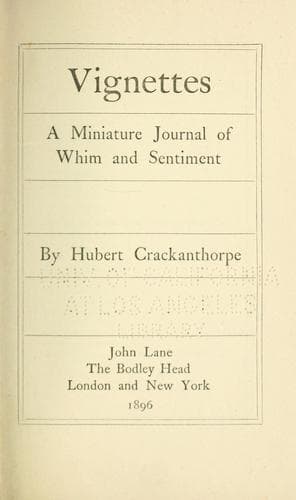
Vignettes: A Miniature Journal of Whim and SentimentCrackanthorpe, Hubert
PhilosophyPhilosophy
Vignettes: A Miniature Journal of Whim and Sentiment
Crackanthorpe, Hubert
English essays -- 19th century; Europe -- Description and travel
She was telling us of her nephew in Tunis—“_Un pays où on ne voit que
des sauvages_”—and of the sweetheart he had left behind at Barbentane;
repeating by heart, one after another, his queer, bald, little
letters—how he had been kicked by his horse (he was a _spahi_; “_zouave
à cheval_” she called it), and had been sick ten days in the hospital;
and how, without telling anyone, she had scraped together a hundred sous
to send out to him. Somehow, irresistibly, while she chattered, I seemed
to see that soldier nephew of hers—broad and straight and bronzed, his
fez stuck jauntily on the back of his head, noisily _noçant avec des
camarades_ with those hundred sous, which old Tante Latou had sent out
to him.
By-and-bye, she related her journey to Valence, in the time when she had
worked as a cherry-packer for Madame Charbonnier in the Rue
Joseph-Vernet, insisting with comical, energetic wrinklings of her
forehead on her contempt for the _jargon de l’Ardèche_.... She had been
to Marseilles, too, last year—that was a great journey—eighteen of them
had gone from Villeneuve, “_femmes et filles et trois garçons, dans un
train ‘ambulant’—quatre francs et douze sous, aller et retour ....
Marseilles, vous savez_,” Jeanne-Marie Latou reiterated, “_c’est quelque
chose ... c’est quelque chose ... c’est quelque chose ... enfin, c’est
la plus jolie ville que j’ai trouvée_.”
Afterwards, starting to recall bygone times, she described the breaking
up of the _Chartreuse_ in _quatre-vingt douze_, and the selling of the
whole building by auction in the little _place_, there, below us (not
for money—no one in the _pays_ had any money in those days—but for
_assignats_), and, Jeanne-Marie Latou explained, “_Ceux qui avaient peur
n’en prenaient pas, et ceux qui n’avaient pas peur en prenaient_.” And
her father, who had been a stone-worker, over there at Les Angles, had
bid _douze cents francs d’assignats_ for the house where the
_supérieure_ had lived—_douze cents francs d’assignats_ which no one had
ever asked him to pay. There Jeanne-Marie Latou had always
lived—seventy-seven years, it was now, as near as she could
remember—she, and her husband who had been dead these twenty-three
years. She could remember the time when the frescoes on the cloister
walls were bright and beautiful, and no grass grew between the flags.
Yes, she had seen all the other houses pass from family to family; there
were six of them now who had the right to use the old church as a barn,
“_ma foi, elle est bien grande, l’église_,” Jeanne-Marie Latou
concluded, smiling knowingly at us, “_Mais, quand même, ils se chicanent
toujours._”...
And with that, she rose slowly and bid us good-bye, and wished us good
health, toddling grotesquely away down the steps.
Public-domain text, read in full here on John Shaqi.
Reviews
Reviews
No reviews yet
Be the first to share your thoughts on this work.
Join the Discussion
Join the discussion
Sign in to leave a comment or review.
Sign InorCreate an account