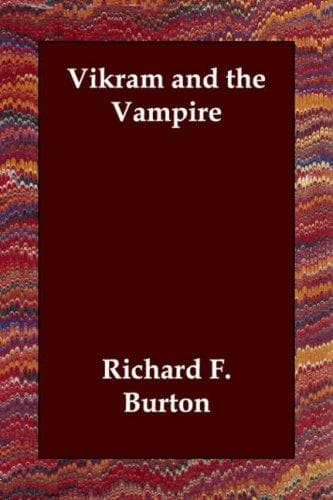
This story turns chiefly on a great king named Vikram, the King Arthur of the East, who in pursuance of his promise to a Jogi or Magician, brings to him the Baital (Vampire), who is hanging on a tree. The difficulties King Vikram and his son have in bringing the Vampire into the presence of the Jogi are truly laughable;This book also inspired the "Golden Asse" of Apuleius, Boccacio's "Decamerone," the "Pentamerone," and all that class of facetious fictitious literature.Please Note: This book is easy to read in true text, not scanned images that can sometimes be difficult to decipher. The Microsoft eBook has a contents page linked to the chapter headings for easy navigation. The Adobe eBook has bookmarks at chapter headings and is printable up to two full copies per year. Both versions are text searchable.
King Vikramaditya was succeeded by his infant son Vikrama-Sena, and
father and son reigned over a period of 93 years. At last the latter was
supplanted by a devotee named Samudra-pala, who entered into his body
by miraculous means. The usurper reigned 24 years and 2 months, and the
throne of Delhi continued in the hands of his sixteen successors, who
reigned 641 years and 3 months. Vikrama-pala, the last, was slain in
battle by Tilaka-chandra, King of Vaharannah[14].
It is not pretended that the words of these Hindu tales are preserved
to the letter. The question about the metamorphosis of cats into tigers,
for instance, proceeded from a Gem of Learning in a university much
nearer home than Gaur. Similarly the learned and still living Mgr. Gaume
(Traite du Saint-Esprit, p.. 81) joins Camerarius in the belief that
serpents bite women rather than men. And he quotes (p.. 192) Cornelius a
Lapide, who informs us that the leopard is the produce of a lioness with
a hyena or a bard..
The merit of the old stories lies in their suggestiveness and in their
general applicability. I have ventured to remedy the conciseness of
their language, and to clothe the skeleton with flesh and blood.
To My Uncle,
ROBERT BAGSHAW, OF DOVERCOURT,
These Tales,
That Will Remind Him Of A Land Which
He Knows So Well,
Are Affectionately Inscribed.
INTRODUCTION
The sage Bhavabhuti--Eastern teller of these tales--after making his
initiatory and propitiatory conge to Ganesha, Lord of Incepts, informs
the reader that this book is a string of fine pearls to be hung round
the neck of human intelligence; a fragrant flower to be borne on the
turband of mental wisdom; a jewel of pure gold, which becomes the brow
of all supreme minds; and a handful of powdered rubies, whose tonic
effects will appear palpably upon the mental digestion of every patient.
Finally, that by aid of the lessons inculcated in the following pages,
man will pass happily through this world into the state of absorption,
where fables will be no longer required.
He then teaches us how Vikramaditya the Brave became King of Ujjayani.
Some nineteen centuries ago, the renowned city of Ujjayani witnessed the
birth of a prince to whom was given the gigantic name Vikramaditya.
Even the Sanskrit-speaking people, who are not usually pressed for time,
shortened it to “Vikram”, and a little further West it would infallibly
have been docked down to “Vik”.
Vikram was the second son of an old king Gandharba-Sena, concerning whom
little favourable has reached posterity, except that he became an ass,
married four queens, and had by them six sons, each of whom was more
learned and powerful than the other. It so happened that in course of
time the father died. Thereupon his eldest heir, who was known as Shank,
succeeded to the carpet of Rajaship, and was instantly murdered by
Vikram, his “scorpion”, the hero of the following pages.[15]
Public-domain text, read in full here on John Shaqi.
Reviews
Reviews
No reviews yet
Be the first to share your thoughts on this work.
Join the Discussion
Join the discussion
Sign in to leave a comment or review.
Sign InorCreate an account