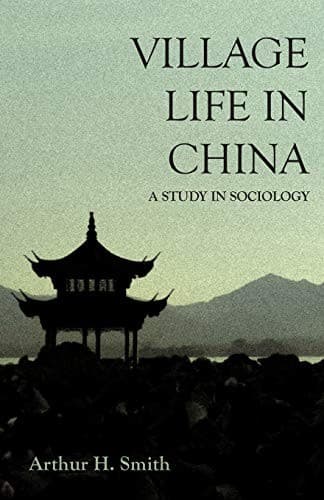
Village Life in China: A Study in SociologySmith, Arthur H.
General
Village Life in China: A Study in Sociology
Smith, Arthur H.
China -- Social life and customs; Villages
Differing by millenniums from the system just described is that recently
decreed after successful agitation by a few reformers. During the summer
of 1898 His Majesty Kuang Hsü, Emperor of China, issued several Edicts
which abolished the "eight-legged examination essay" as an avenue to the
attainment of literary degrees, and introduced in their place what was
termed Practical Chinese Literature, and Western Learning, which were to
be combined in Provincial and County Academies. Existing institutions
were to be remodelled after a more or less definite pattern set in Peking.
All except official temples (that is, those where offerings or services
were required from the Magistrates) were to be surrendered as seats of the
New Learning. Reports were demanded from Provincial Governors as to the
present status of these temples, and the future prospects for income from
them.
These Edicts potentially revolutionized the intellectual life of China.
They were received very differently in different parts of the empire, but
there is no reason to doubt that they would have been widely welcomed by
an influential minority of the literati of China, who had in various ways
come to realize the futility of the present instruction for the needs of
to-day. The immediate effect was to bring Western Learning into universal
demand. Scholars who had never deigned to recognize the existence of
foreigners, were now glad to become their pupils and purchasers of their
text-books on a large scale. For a few weeks examination themes were
strongly tinctured with Western topics, and those who were able to show
any familiarity with those branches of learning were almost sure of a
degree. Correct answers to simple mathematical, geographical, or
astronomical questions are said to have rendered success certain, and it
is even alleged that a candidate in one place took his honours by writing
out and commenting upon the Ten Commandments, which he represented as The
Western Code of Laws.
Toward the close of September, 1898, the Empress Dowager seized the reins,
suppressed her nephew, and nearly all reforms, educational and political,
were extinguished. A new Imperial University in Peking survived the storm,
but almost all of the extended and beneficent program of His Majesty was
relegated to the Greek Kalends. It is only a question of time when the
pendulum shall swing back, but every well-wisher of China hopes that it
may not be delayed until the national existence of the Chinese shall have
been lost.
XI
VILLAGE TEMPLES AND RELIGIOUS SOCIETIES
Public-domain text, read in full here on John Shaqi.
Reviews
Reviews
No reviews yet
Be the first to share your thoughts on this work.
Elsewhere in the archive
Join the Discussion
Join the discussion
Sign in to leave a comment or review.
Sign InorCreate an account