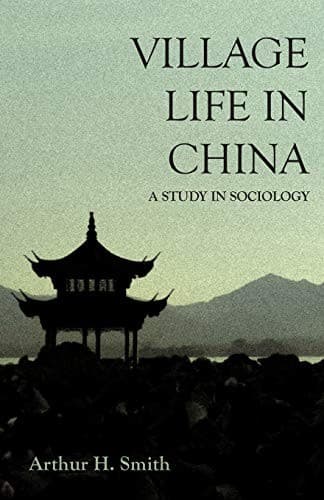
Village Life in China: A Study in SociologySmith, Arthur H.
General
Village Life in China: A Study in Sociology
Smith, Arthur H.
China -- Social life and customs; Villages
The village graduate who knows how to help in lawsuits by preparing
complaints, and by assisting in the intricate proceedings ensuing at each
stage is often able by means of the prestige thus gained, to get his
living at the expense of others more ignorant. No country offers a better
field for such an enterprise than China. Unbounded respect for learning
coexists with unbounded ignorance, and the experienced literary man knows
how to turn each of these elements to the very best account. In all lands
and in all ages, the man who is possessed with what is vulgarly termed the
"gift of the gab," is able to make his own way, and in China he carries
everything before him.
The range of territory which any aspirant for literary honours in China
must expect to traverse, is, as we have seen, continental. In order to
have any hope of success, he must be acquainted with every square inch of
it, and must be prepared to sink an artesian well from any given point to
any given depth. To the uneducated peasant, whose whole being is
impregnated with a blind respect for learning, amounting at times to a
kind of idolatry, such knowledge as this seems an almost supernatural
acquirement, and inspires all the reverence of which he is capable. The
thought of the estimate in which they will be held for the whole term of
their lives, is thus a powerful stimulus to scholars of ambition, even
under the greatest discouragements.
There could scarcely be a better exemplification of what the Chinese
saying calls "superiority to those below, and inferiority to those above,"
than the position of the hsiu-ts'ai. While he is looked upon by the vulgar
herd in the light we have described, by the educated classes above him he
is regarded, as we have so often termed him, as a schoolboy who is not yet
even in school. The popular dictum avers that though the whole body of
hsiu-ts'ai should attempt to start a rebellion, and should be left
undisturbed in the effort for three years, the result would be failure,
albeit this proverb finds no support in the history of the great
rebellion, which originated with a discontented undergraduate who was
exasperated at his repeated failures to get his talent recognized.
Literary examinations, as we have abundantly seen, are like the game of
backgammon, an equal mixture of skill and luck, but the young graduate
easily comes to regard the luck as due to the skill, and thus becomes
filled to the full of that intellectual pride which is one of the greatest
barriers to the national progress of China.
Public-domain text, read in full here on John Shaqi.
Reviews
Reviews
No reviews yet
Be the first to share your thoughts on this work.
Elsewhere in the archive
Join the Discussion
Join the discussion
Sign in to leave a comment or review.
Sign InorCreate an account