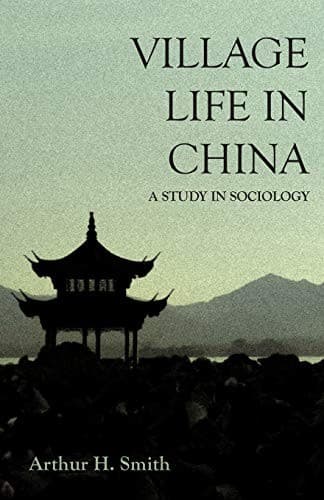
Village Life in China: A Study in SociologySmith, Arthur H.
General
Village Life in China: A Study in Sociology
Smith, Arthur H.
China -- Social life and customs; Villages
According to Chinese ideas the "Three Harmonies" are "Heaven, Earth, and
Man." All three of them are at present out of sorts with each other. What
is imperatively needed is a reconciliation, but this can never be had
until the Chinese come to a more accurate appreciation of the limits of
the powers of each of the triad. A new set of men would soon make a new
earth, and then the heavens would be found to be well enough as they are.
In the course of ten years enough water falls for the use of all, and not
too much to be managed. But man must learn how to control it, and until he
does so, "Heaven, earth and man" will never be in right relations.
XVII
THE VILLAGE HUNT
There are parts of the wide province of Shan-tung, in which there are
great sheets of clear and deep water much frequented by water-fowl,
especially in the autumn and in the winter. In any Western land these
districts would be the paradise of hunters, but here the ducks and the
geese go their several ways in "peace and tranquillity along the whole
road," undisturbed by the gun of the sportsman or the pot-hunter. This is
due to an old-time custom of the yamên in the Prefectural city contiguous
to the largest marshes, of levying a squeeze on the results of the
gunner's toil, a squeeze so comprehensive and virtually prohibitory in its
action that water-fowl are practically out of the market altogether.
There is a record in the life of Dr. Medhurst, one of the pioneer
missionaries in China, and father of Sir Walter Medhurst, sometime Her
Majesty's Consul-General in Shanghai, of a trip which he and a companion
made north from Shanghai along the coasts of Shan-tung. Their plan was to
debark from the fishing junk in which they had taken passage, cut across
from one headland to another and then rejoin their vessel to repeat the
same process farther on. In this way they succeeded in penetrating to a
few fishing villages and had conversation with a handful of people all
along shore. With charming frankness the historian of this pioneer tour
mentions that they nowhere saw any wild animals. We can readily believe
him, for even at this advanced stage of extended exploration, the only
wild animal that the most experienced traveller is likely to see is the
hare, albeit there are sundry others such as weasels, a kind of
ground-fox, and the like, which do not obtrude themselves to any extent in
public.
Public-domain text, read in full here on John Shaqi.
Reviews
Reviews
No reviews yet
Be the first to share your thoughts on this work.
Elsewhere in the archive
Join the Discussion
Join the discussion
Sign in to leave a comment or review.
Sign InorCreate an account