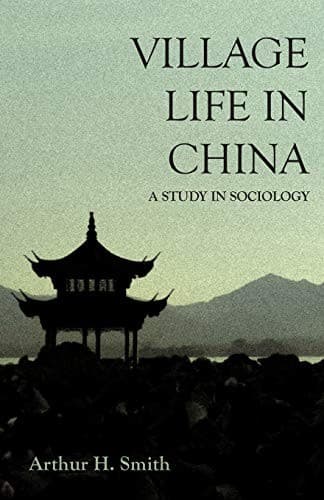
Village Life in China: A Study in SociologySmith, Arthur H.
General
Village Life in China: A Study in Sociology
Smith, Arthur H.
China -- Social life and customs; Villages
Now what was the _motive_ for all this? Was there a feud between these
villages? By no means, but exceptional amity, six or eight families being
connected by marriage. Was there any special provocation? None whatever;
all comprehensible _motives_ led to a continuance of peace, but war and
bloodshed followed just the same. Much may be accounted for by Chinese
passion, but how can passion be suddenly made out of nothing? It is the
current fashion to explain all phenomena, celestial and terrestrial, in
terms of the development theory. Given heredity, education and environment
and you have the man, and society. But it is questionable whether this
classification is as exhaustive as it seems. At times another factor
appears to be required. It is what Edgar Poe called the Imp of the
Perverse.
XVIII
VILLAGE WEDDINGS AND FUNERALS
The Chinese share with the rest of the human race a desire to make a
marriage ceremony an occasion of joy. One of the most frequent periphrases
for a wedding, is the expression "joyful event." It is in China
preëminently true that the highest forms of "joy," find expression in
eating. While marriage feasts are no doubt to be found in all lands at all
times, they are especially Oriental, and are characteristic of the
Chinese.
Owing to the extent and the intricate ramifications of Chinese
relationships, the number of persons who must be invited to a wedding is
very large. In some regions it is customary for women only to contribute a
"share" (_fên-tsŭ_) to a wedding, while the men give a present at that
part of the ceremony when the bridegroom salutes the guests in turn with a
prostration. As the name of each guest is called to be thus honoured, he
hands over the amount of his offering. But in other places men and women
contribute in the same way. Of two things, however, one may be confident;
that nearly all those invited will be present either in person or by a
representative; and that nearly every woman will be accompanied by
children, who contribute nothing to the revenues, but add enormously to
the expenses.
Marriage customs in China certainly vary widely, but of such a thing as
being present at "the ceremony," but not at "the wedding breakfast," we
have never heard. Indeed, it can scarcely be said that, in our sense of
the word, there is any "ceremony." Whatever may be added or subtracted
from the performances, the essence of a Chinese wedding seems to consist
in the arrival of the bride at her future home. The "feast" is the main
feature of the occasion. Sometimes the relatives are not invited at all
upon the wedding day, but at a subsequent one; yet it is not the less true
that when the guests do come, the "feast" is the centre and soul of the
occasion.
Public-domain text, read in full here on John Shaqi.
Reviews
Reviews
No reviews yet
Be the first to share your thoughts on this work.
Elsewhere in the archive
Join the Discussion
Join the discussion
Sign in to leave a comment or review.
Sign InorCreate an account