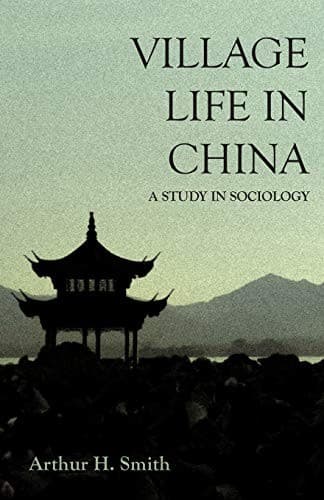
Village Life in China: A Study in SociologySmith, Arthur H.
General
Village Life in China: A Study in Sociology
Smith, Arthur H.
China -- Social life and customs; Villages
If there is anything which the Chinese have reduced to an exact science,
it is the business of eating. The sign of real friendship is to invite a
man to a meal, and it is a proverbial saying that he who comes bearing a
vessel of wine on his shoulder and leading a sheep, is the truly
hospitable man, for he shows by his acts that his invitation is a real
one. The great mass of the Chinese spend their days in a condition which
is very remote from affluence, but the expenses of weddings and funerals
in the mere matter of eating, are such as must, from the extent of such
expenses and the frequency of the occasions upon which they are required,
reduce any but a very affluent family to utter poverty.
Under the pressure of these inexorable circumstances, the Chinese have
long ago hit upon an application of the share principle, by means of which
wedding and funeral feasts become quite practicable, which would otherwise
remain an utter impossibility. It can seldom be known with certainty how
many guests will attend a wedding, or funeral, but the provision must be
made upon the basis of the largest number likely to appear. Each guest, or
rather each family, is not only expected, but by a rigid code of social
etiquette required, as already mentioned, to contribute to the expenses of
the occasion by a "share." This will sometimes be in food, but the general
practice is to bring money, according to a scale which is perfectly
understood by every one. The amount varies greatly in different places,
from a trifling sum of the value of about five or six cents up to a
quarter of a dollar or more, according to the degree of intimacy between
the persons, and the ability of the guests to contribute. In some parts of
China, the ordinary amount taken to such a feast seems to be twice as
great as in others. Sometimes the standard is so well understood, that the
phrase "a share" has a local meaning as definite as if, for example, the
sum of 250 cash were expressly named.
In some places while the rate of "a share" for a funeral is 250 cash, that
for a wedding is just double. This is because the food at a funeral is
"plain" (_su_), while that for the wedding is of meat (_hun_) and much
more expensive. It is not uncommon to find that "a share" for a person who
comes from another city or district is two or three times that of a native
of the place where the feast is given. To give only the same as a native
would do would be considered for the person from a distance as a loss of
"face"!
Public-domain text, read in full here on John Shaqi.
Reviews
Reviews
No reviews yet
Be the first to share your thoughts on this work.
Elsewhere in the archive
Join the Discussion
Join the discussion
Sign in to leave a comment or review.
Sign InorCreate an account