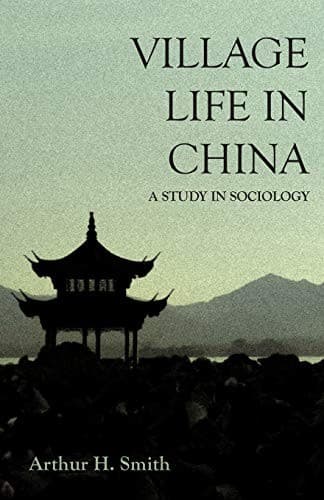
Village Life in China: A Study in SociologySmith, Arthur H.
General
Village Life in China: A Study in Sociology
Smith, Arthur H.
China -- Social life and customs; Villages
In cities and large towns, the business of managing a wedding or a funeral
feast, is conducted much as it would be in any country of the West. A food
shop contracts to deliver so many bowls of food of a definite quality and
at a fixed price. Provision is also made for additional supplies should
the number of guests be unexpectedly great. But if the feast is to be on a
large scale, it is not unlikely that the cooking will be done on the
premises by the professional caterers. It is usual to speak of an affair
of this sort as embracing so many "feasts," a "feast" denoting not a
single individual, as might be supposed, but the number who can sit at one
table. This number, like everything Chinese, varies in different places.
Sometimes it is eight, and the phrase, "eight fairy table" is the common
designation of the articles of furniture required for the purpose.
In other regions, while all the tables are of the same size and shape as
these, one side is left open for convenience in passing the food, and a
"feast" signifies six persons only. When the feasts are provided by
contract, the establishment also furnishes waiters, who convey the food to
the guests, and to these waiters a small gratuity is given at the close.
The number of families who are within reach of facilities such as these,
is but a small proportion of those who are obliged to arrange for feasts
at weddings and funerals. For those to whom no such resource is open,
there is no other way but to put the matter into the hands of certain
experts, of great experience in such matters--a class of persons to be
found everywhere. Every village or group of villages can furnish a
professional cook, who devotes much of his time to the conduct of affairs
of this sort. If he is a man of wide reputation, and employed by rich
families, he will have a number of assistants who work under his
direction, all of whom at the close of the feast will be rewarded with
suitable gratuities.
The staff of persons into whose hands the business of arranging for a
feast is committed, is divided into three departments or committees, the
Stewards (_chih fang_), the Culinary Department (_ch'u-fang_), and Finance
Department (_chang-fang_). Each of them is a check upon the other two,
although in the smaller and less expensive affairs all three will
naturally run together and be merged in a single head. The Stewards
purchase such supplies as are supposed to be necessary, embracing the best
which the local market affords.
Public-domain text, read in full here on John Shaqi.
Reviews
Reviews
No reviews yet
Be the first to share your thoughts on this work.
Elsewhere in the archive
Join the Discussion
Join the discussion
Sign in to leave a comment or review.
Sign InorCreate an account