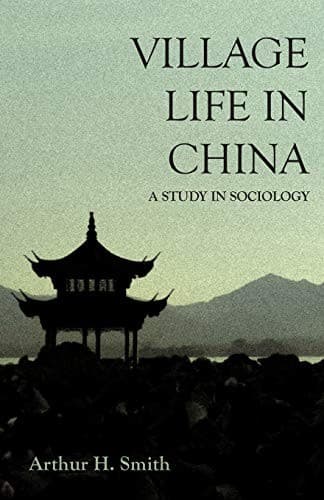
Village Life in China: A Study in SociologySmith, Arthur H.
General
Village Life in China: A Study in Sociology
Smith, Arthur H.
China -- Social life and customs; Villages
It is a characteristic example of Chinese procedure that the sums
contributed upon occasions of this sort are in reality seldom what they
profess to be. If local custom considers ninety-eight or ninety-six cash
as a hundred, the temptation to put in a less number as a contribution is
generally too strong to be resisted; the more so as in the confusion of
receiving the numerous amounts, it is generally difficult to tell which
particular string of cash was sent in by which persons, although the
amounts are all entered in an "account," to be presently noticed.
Those householders who are very anxious to keep exact track of the
relative honesty of the respective contributors, sometimes do so by having
ready a long cord to which each successive sum of cash is tied by its
string, after the sum is entered on the account. When the proceedings are
ended, it will then be possible for the master of the house to go over the
multitudinous strings of cash, ascertaining how much each one is short,
and tracing it to its donor by its place on the cord, corresponding to the
order of entry in the account-book. But this plan is not regarded with
favour by the guests, and is not generally adopted, because it makes so
much trouble. The advantage of it is that it enables the householder to
pay off the debt to the family which gave short cash, at exactly the same
rate, whenever they invite him to a wedding or a funeral. In some places
it is well understood that though each guest contributes "a share" of 250
cash, it will take five "shares" to make 1,000, since every "hundred cash"
is in reality only eighty.
It is the duty of the committee which looks after the finances, to take
charge of all sums which may be brought by the guests, and to keep a
record of the amount paid by each. This is a matter of great importance,
as every such contribution occupies the double position of a repayment of
some similar gift to the family of the giver, by the family which now
receives the gift, and also of a precursor of similar return gifts in time
to come. The amount which is sent by each person will depend upon the
relations existing between the families, and especially upon the amount
received by them on some former similar occasion. To disregard the
unwritten code which demands from guests proportional contributions, is
regarded as a grave offence against decorum, because of its serious
consequences to the family concerned, in diminishing their receipts.
To attend a feast, but not to bring any contribution, either in money or
in kind, seems to be practically unknown, though it constantly happens
that the quantity of food which on certain occasions may be substituted
for money, is less than half of what is eaten by the donor. This is
especially the case when the giver is a woman, who, as already mentioned,
is likely to bring one or more voracious children, who must be pacified by
food at every stage of the performances, their capacities being apparently
absolutely unlimited.
Public-domain text, read in full here on John Shaqi.
Reviews
Reviews
No reviews yet
Be the first to share your thoughts on this work.
Elsewhere in the archive
Join the Discussion
Join the discussion
Sign in to leave a comment or review.
Sign InorCreate an account