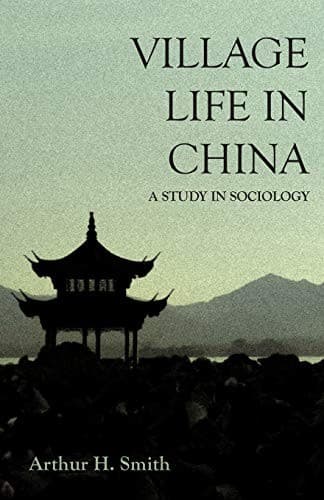
Village Life in China: A Study in SociologySmith, Arthur H.
General
Village Life in China: A Study in Sociology
Smith, Arthur H.
China -- Social life and customs; Villages
We have but to imagine the application of the principles which we have
named, to the whole Chinese empire, and we get new light upon the nature
of the Chinese New Year festivities. They are a time of rejoicing, but
there is no rejoicing so keen as that of a ruined debtor, who has
succeeded by shrewd devices in avoiding the most relentless of his
creditors and has thus postponed his ruin for at least another twelve
months. For, once past the narrow strait at the end of the year, the
debtor finds himself again in broad and peaceful waters, where he cannot
be molested. Even should his creditors meet him on New Year's day, there
could be no possibility of mentioning the fact of the previous day's
disgraceful flight and concealment, or indeed of alluding to business at
all, for this would not be "good form," and to the Chinese "Good Form"
(otherwise known as Custom), is the chief national divinity.
An ingenious device by which to secure the desirable result that a family
shall be sure to have a supply of the food most indispensable for a proper
treatment of guests at the festive New Year season, is found in what are
called New Year Societies. Each member of the society contributes a few
hundred or perhaps a thousand cash a month for the first five months of
the year, until the wheat harvest in June when wheat is at its lowest
price, for example 1,200 cash for 100 catties or picul. During the five
months which have elapsed, the money thus assessed upon the members has
been put at interest, and has already accumulated a handsome income. As
soon as the new wheat is in the market, the loans are all called in, and
the treasurer takes the whole of the sum belonging to the association and
invests it in wheat. This he keeps until the close of the year, by which
time it is not at all unlikely that the price of the grain has doubled. He
then exchanges the wheat, at the current rate, with some maker of
bread-cakes (_man-t'ou_), and these are divided among the stockholders. In
this way, each one gets not only the benefit of the interest on loans for
five months, but also nearly or quite double the value of the wheat bought
just after harvest. Sometimes the monthly payments are continued
throughout the year, and the sum is then expended in a lump for
bread-cakes, wheat, cotton, or whatever each family most needs for the New
Year season. In societies of this kind, the rate of interest is sure to be
at least three per cent. per month, and perhaps four per cent. The amounts
borrowed are usually small, and each borrower must have a security from
among the contributors to the fund. In case payment is not forthcoming at
the due date, the next step is to raise an uproar, and if possible to
collect the debt by force. The inevitable and universal uncertainty and
difficulty attending the collection of any money on loan, give emphasis to
the adage that "where the profit is large, the risk is correspondingly
great."
Public-domain text, read in full here on John Shaqi.
Reviews
Reviews
No reviews yet
Be the first to share your thoughts on this work.
Elsewhere in the archive
Join the Discussion
Join the discussion
Sign in to leave a comment or review.
Sign InorCreate an account