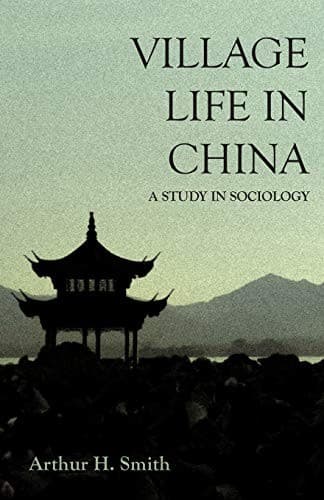
Village Life in China: A Study in SociologySmith, Arthur H.
General
Village Life in China: A Study in Sociology
Smith, Arthur H.
China -- Social life and customs; Villages
Extortionate as are the ordinary rates of Chinese interest, ranging from
twenty-four to forty eight or more per cent. per annum, there are other
ways than direct loans, by which even greater profits may be gathered. The
passion for gambling seems to be all-pervasive among the Chinese, and it
is perhaps a greater bar to the prosperity of the common people than any
other habit of their lives. Many of the phenomena of Chinese coöperation
are associated with gambling practices, from which the profit to those who
manage the finances is very great. In all cases where there is money to
loan, it is possible to employ it for gaming, under the direction of the
managers, or trustees. Those who are in the habit of gambling do not stop
when their supply of money fails, but draw upon the bank of the loan
association at terms which are agreed upon, but which differ according to
circumstances. In an emergency, it might happen that a person whose
fortune had failed him, would be obliged to borrow of the bank, say 800
cash, which in a short time he must replace with 1,000. At the end of the
year when the accounts are made up and the money paid in, it is equally
divided among the contributors of the society, whether they may have used
the capital for gambling or not. In case they have borrowed a part of the
capital and are not able to repay it, their debt is set against their
contribution, and they lose their investment.
XX
THE VILLAGE BULLY
No adequate understanding of the life of the Chinese is possible without
some comprehension of the place therein of the bully, and conversely it
might almost be said that a just apprehension of the character and
functions of the Chinese bully is equivalent to a comprehension of Chinese
society.
So far as we know, the Chinese bully is a character peculiar to China. By
this it is not of course meant that other lands do not have and have not
always had their bullies, but that the mode in which Chinese bullies exert
their power is unique. It depends largely upon the peculiar
characteristics of the Chinese race, prominent among which is the desire
for peace, and a reluctance to engage in a quarrel. The traits of a bully
among a savage and warlike people such as our ancestors once were, and of
a bully among such a quiet folk as the Chinese, are inherently different.
The Chinese have many terms to designate the individual whom we have
termed a bully, among which one of the most common is that which means
literally "bare-stick" (_kuang-kun_), in allusion to the fact that those
who are most frequently bullies are generally those who have no property
to lose. But the general term is applicable to any one who plays the part,
whatever his social condition may be, and it is in this sense that we
shall employ it.
Public-domain text, read in full here on John Shaqi.
Reviews
Reviews
No reviews yet
Be the first to share your thoughts on this work.
Elsewhere in the archive
Join the Discussion
Join the discussion
Sign in to leave a comment or review.
Sign InorCreate an account