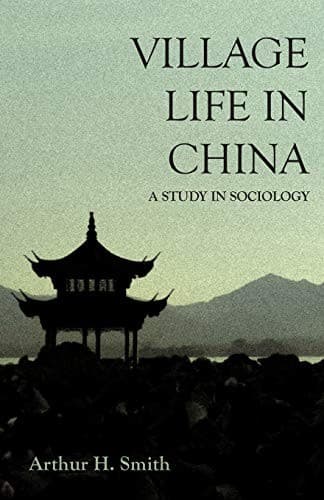
Village Life in China: A Study in SociologySmith, Arthur H.
General
Village Life in China: A Study in Sociology
Smith, Arthur H.
China -- Social life and customs; Villages
His cap is worn studiedly awry; his outer garment instead of being
decorously fastened, is left purposely unlooped; his abundant hair is
braided into a loose cue apparently as thick as his arm, the plaiting
beginning several inches away from the head: the end of the cue is
generally coiled about his neck or over his head (a gross breach of
Chinese etiquette), as if to show that he thirsts for a fight. His outer
leggings are not improbably so tied as to display a lining which is more
expensive than the outside; and his shoes are invariably worn down at the
heel, perhaps to make an ostentatious display of a silk embroidered _heel_
to the cotton stocking--a touch of splendour adapted to strike awe into
the rustic beholder. In a time of intense excitement over alleged
kidnapping of children, we have known a man to be apprehended in open
court and examined as a bad character, because the colour of his clothes
was unusual.
By persistently following out his peculiar lines of action, he will not
unlikely succeed in diffusing the impression that he is a dangerous man to
interfere with, and will in consequence be let severely alone. A cat of
even a small experience will not improbably manifest considerable
hesitation before attempting to swallow a lizard. It is evident,
therefore, that if any small reptile is obliged to associate with cats,
the art of simulating a lizard is a valuable one. The grade of bully of
which we are now speaking is in all Chinese society too common to attract
much notice, and he can be avoided by letting him alone. His weapons, like
the walls of Chinese cities, are defensive only.
Much more to be dreaded is the bully who will not let others alone, but
who is always inserting himself into their affairs with a view to
extracting some benefit for himself. The most dangerous type of these men
is the one who makes very little ado, but whose acts are ruinous to those
whom he wishes to injure. Such a one is aptly likened to a dog which bites
without showing his teeth.
The tactics which such a man adopts to establish his claim to the rank of
"village king," are the same with which we are only too familiar in other
lands, and which an advancing civilization has not yet succeeded in
rendering wholly obsolete. If there is no overt act which he sees his way
to commit, he can always pick a quarrel by reviling, which is regarded as
throwing down a glove of defiance. Not to notice such a challenge is from
a Chinese standpoint almost impossible. "To be reviled and to feel no
pain," this is the Chinese ideal of shamelessness. Nothing is rarer than
to find a Chinese who has been reviled, and who, when he was strong enough
to demand an apology, has allowed the matter to drop.
Public-domain text, read in full here on John Shaqi.
Reviews
Reviews
No reviews yet
Be the first to share your thoughts on this work.
Elsewhere in the archive
Join the Discussion
Join the discussion
Sign in to leave a comment or review.
Sign InorCreate an account