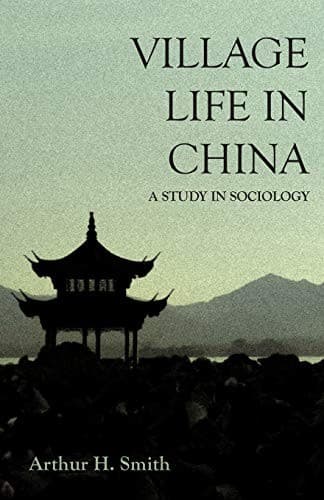
Village Life in China: A Study in SociologySmith, Arthur H.
General
Village Life in China: A Study in Sociology
Smith, Arthur H.
China -- Social life and customs; Villages
In this connection it is worth noting that the foreigner in China suffers
from a chronic embarrassment as to how to address a Chinese. There is in
the language no term answering to our Mister or Master, the nearest
equivalent being the words Elder-born or Seignor (_Hsien-shêng_). The
expression properly connotes a Teacher in reality or by courtesy, and
although applied indiscriminately to blind men (even if they should be
beggars) will not serve for general use. Honourific terms abound, but in
the rural regions these are not in use, and are but dimly comprehensible.
On the principle that "Within the four seas all are brethren," it is the
Chinese habit to _assume the existence_ of a relationship, so that the
passing stranger may appropriately call out to one whom he has never seen
before: "Great elder-brother may I borrow your light and inquire whether
this is the right road to Peking?" Should the person addressed be an old
man, the title would be changed to Uncle or Grandfather. The fact that the
term for an older uncle differs from that for a younger one, embarrasses
the foreigner by forcing upon him a decision of the difficult question
which one to use, for deciding which point he often has absolutely no
data.
A Chinese married woman has literally no name at all, but only two
surnames, her husband's and her father's, so that when these chance to be
common ones, it is impossible by this means to discriminate one woman from
another. If Chinese women are to be addressed by strangers at all, there
is even more embarrassment than in the case of men. In some regions the
term Elder-sister-in-law (_sao-tzŭ_) serves indiscriminately for any
woman, but in others Aunt (_la-niang_) must be used, while in yet others
nothing is appropriate but Grandmother (_nai-nai_) which elsewhere would
be equivalent to Old Granny. When there happen to be three generations of
women in the same family to dub them all "Grandmother" (especially if one
of them is a girl in her teens just married) is flagrantly absurd. Beggars
at the other gates clamour to have their "Aunts" bestow a little food, and
the phrase Old Lady (_lao T'ai-t'ai_) is in constant use for any woman
past middle life.
The age at which a boy is too large to be carried is a very indefinite
one, and it is common to see distracted mothers staggering with their
little goat-feet under the weight of children half their own size, lugging
their offspring about for the reason that "they would not stand it" to be
put down. A preparatory discipline of this nature is not adapted to teach
children independence, self-control, or any useful lessons, and the result
is such as might have been expected. But the Chinese child is an eminently
practical being, and he finds by experience that, when there are half a
dozen children smaller than himself, the period of his own supreme rule
has passed away, and has passed away never to return. To this altered
condition he soon learns to adapt himself.
Public-domain text, read in full here on John Shaqi.
Reviews
Reviews
No reviews yet
Be the first to share your thoughts on this work.
Elsewhere in the archive
Join the Discussion
Join the discussion
Sign in to leave a comment or review.
Sign InorCreate an account