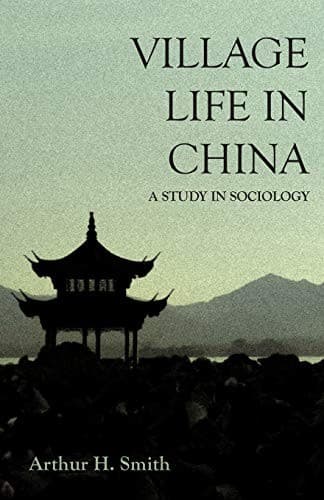
Village Life in China: A Study in SociologySmith, Arthur H.
General
Village Life in China: A Study in Sociology
Smith, Arthur H.
China -- Social life and customs; Villages
It is a highly convenient arrangement of Chinese family nomenclature, that
the names of each member of the same generation (within certain defined
degrees of cousinship) furnish a clue to his relationship to the rest.
Thus, if a man's surname is Wang, his family name (which can be either two
characters or one) may be compounded with the character denoting Spring,
in which case one brother might be called Wang Spring-Flowers, the next
Wang Spring-Fragrance, a third Wang Spring-Fields, and so universally for
that generation as far away among the cousins as the Spring influence
penetrates. These family names are theoretically recorded in carefully
kept registers, and must not be repeated in later generations, or only
after the lapse of a due number of generations. Memorials sometimes appear
in the _Peking Gazette_ from high officials asking permission to have a
family name altered, since a repeated title has inadvertently been taken.
This use of the same characters in Chinese family names has often been
compared to the Anglo-Saxon habit of bestowing upon brothers names of
which one syllable is constant, as Edward, Edwin, Edmund, Edgar, etc.
Besides the name, there is the "style," often much more in use than any
other designation, which may be bestowed upon the owner by a friend. It is
common by a respectful familiarity to prefix to the first character of the
style, the honourific "Old," (_Lao_) making still another title. Thus
supposing Mr. Wang Spring-Fragrance has the style of Illustrious Virtue,
his common appellation may be Wang Old Illustrious, his other names being
used as alternatives. The result of all this is that a single Chinese not
infrequently appears to be three and sometimes four, since students have
also their examination names, differing, strange to say, from any which
they have hitherto borne. The confusion attending the addressing of
Chinese letters in correspondence would be intolerable to an Occidental.
Aside from the ambiguities already mentioned, it sometimes appears to the
writer of a letter a happy expedient to employ a title on the back of his
epistle, known only to himself and to the recipient, to the great
bewilderment of the persons through whose hands the missive may pass. We
have seen a Chinese teacher invited to inspect the address of a letter of
this sort, the destination of which neither he nor any one else could
decide. Yet it subsequently turned out that the epistle was meant for his
own son! With all this labyrinth of future complexity the village boy is
very little concerned, often passing through life without any name at all
to speak of.
Public-domain text, read in full here on John Shaqi.
Reviews
Reviews
No reviews yet
Be the first to share your thoughts on this work.
Elsewhere in the archive
Join the Discussion
Join the discussion
Sign in to leave a comment or review.
Sign InorCreate an account