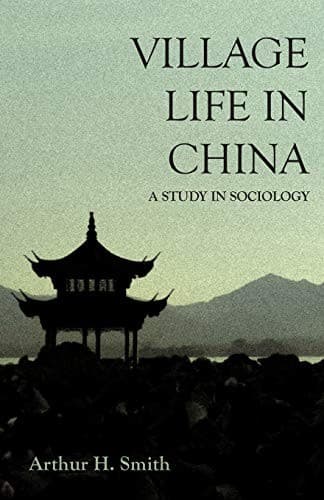
Village Life in China: A Study in SociologySmith, Arthur H.
General
Village Life in China: A Study in Sociology
Smith, Arthur H.
China -- Social life and customs; Villages
Chinese villages are only individual Chinese amplified, and, like
individuals, they are liable to be nicknamed; and, as often happens with
human beings, the nickname frequently supplants the original, of which no
trace may remain in memory. This helps to account for the singular
appellations of many villages. A market-town on the highway, the wells of
which afford only brackish water, was called "Bitter Water Shop," but as
this name was not pleasing to the ear, it was changed on the tax lists to
"Sweet Water Shop." If any one inquires how it is that the same fountain
can send forth at the same time waters both bitter and sweet, he is
answered with conclusive simplicity, "Sweet Water Shop is the same as
Bitter Water Shop!" A village situated on the edge of a river was named
after the two leading families, but when the river rose to a great height
this name sunk out of sight, and there emerged the title, "Look at the
Water;" but even this alteration not being sufficient to satisfy the
thirst for variety, the name is written and pronounced as if it meant,
"Look at the Grave!" A hamlet named for the Liu Family had in it a bully
who appeared in a lawsuit with a black eye, and hence was called the
Village of Liu with the Black Eye. In another instance a town had the name
of Dropped Tooth, merely because the local constable lost a central
incisor (Lao Ya Chên); but in course of time this fact was forgotten, and
the name altered into "Market-town of the Crows," (Lao Kua Chên) which it
still retains.
A village in which most of the families joined the Roman Catholics and
pulled down all their temples, gained from this circumstance the
soubriquet of "No Gods Village" (Wu Shên Chuang). The following specimens
of singular village names are all taken from an area but a few miles
square, and could doubtless be paralleled in almost any other region. "The
Imperial Horse Yard" (Yü Ma Yüan). This title is said to have been
inherited from the times of the founder of the Sung Dynasty. It is
generally corrupted into "Sesame Garden," (Chih Ma Yüan). "End of the
Cave," a village situated on a great plain, with vague traditions of an
underground passage. "Seeing the Horse"; "Horse Words Village," from a
tradition of a speaking animal; "Sun Family Bull Village"; "Female Dog
Village"; "Wang Family Great Melon Village"; "Separating from the King
Village"; "Basket Village of the Liu Village"; "Tiger-catching Village,"
and "Tiger-striking Fair"; "Duck's Nest of the Chou Family"; "Horse
Without a Hoof"; "Village of Chang of the Iron Mouth"; "Ts'ui Family Wild
Pheasant Village"; "Wang Family Dog's Tooth"; "Village of the Benevolent
and Loving Magistrate"; "Village of the Makers of Fine-tooth Combs,"
(Pi-tzŭ-chiang Chuang), which is now corrupted into "The Village Where
They Wear Pug-noses"!
[Illustration: THE VILLAGE COBBLER.]
[Illustration: VILLAGE BROOM-MAKER.]
IV
COUNTRY ROADS
Public-domain text, read in full here on John Shaqi.
Reviews
Reviews
No reviews yet
Be the first to share your thoughts on this work.
Join the Discussion
Join the discussion
Sign in to leave a comment or review.
Sign InorCreate an account