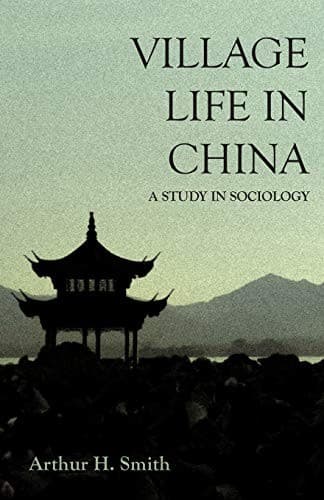
Village Life in China: A Study in SociologySmith, Arthur H.
General
Village Life in China: A Study in Sociology
Smith, Arthur H.
China -- Social life and customs; Villages
The imminent risk that the girl might in some unguarded moment be actually
_seen_ by the family of the future mother-in-law is a reason why so few
engagements for girls are made in the town in which the girl lives, an
arrangement which would seem to be for the convenience of all parties in a
great variety of ways. It would put a stop to the constant deceptions
practiced by the middle-women, or professional match-makers, whose only
object is to carry through whatever match has been proposed, in order to
reap the percentage which will accrue to the agent. It would do away with
the waste of time and money involved in transporting brides from one of
their homes to the other, often at great inconvenience and loss. It would
make the interchange of little courtesies between the families easy and
frequent. But for all these advantages the Chinese do not seem to care,
and the most frequent explanation of the neglect of them is that there
would be the risk already mentioned. When these two families are such as
would in the ordinary course of events be likely to meet, nothing is more
amusing to a foreigner than to watch the struggles which are made to avert
such a catastrophe. One is reminded of some of our childhood's games, in
which one party is "poison" and the other party is liable to be "poisoned"
and must at all hazards keep out of the way. The only difference between
the cases is that in the Chinese game, _each party_ is afraid of being
"poisoned," and will struggle to prevent it. There is one set of
circumstances, however, in which, despite their utmost efforts, Fate is
too much both for the poisoners and the poisoned. If during the betrothal
a death of an older person takes place in the family of the mother-in-law,
it is generally thought necessary that the girl (who is considered as
already "belonging" to that family) should be present and should perform
the same reverence to the coffin of the deceased as if she had been
already married. She is (theoretically) their daughter; why should she
not come and lament like the rest?[3] If it is possible to arrange it,
however, the marriage will be hastened, in the event of a death of a
person belonging to an older generation, even if a later date had been
previously set.
Public-domain text, read in full here on John Shaqi.
Reviews
Reviews
No reviews yet
Be the first to share your thoughts on this work.
Elsewhere in the archive
Join the Discussion
Join the discussion
Sign in to leave a comment or review.
Sign InorCreate an account