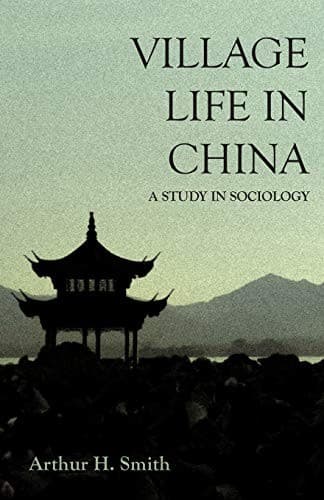
Village Life in China: A Study in SociologySmith, Arthur H.
General
Village Life in China: A Study in Sociology
Smith, Arthur H.
China -- Social life and customs; Villages
In the rainy season the fields are drained into the road, which at such
times is constantly under water. A slight change of level allows the water
to escape into some still lower road, and thus a current is set up, which
becomes first a brook, and then a rushing torrent, constantly wearing out
its bed. This process repeated for decades and for centuries turns the
road into a canal, several feet below the level of the fields. It is a
proverb that a road 1,000 years old becomes a river, just as a
daughter-in-law of many years' standing gradually "summers into a
mother-in-law."
By the time the road has sunk to the level of a few feet below the
adjacent land, it is liable to be wholly useless as a thoroughfare. It is
a canal, but it can neither be navigated nor crossed. Intercourse between
contiguous villages lying along a common "highway," is often for weeks
together entirely interrupted. The water drained from the land often
carries with it large areas of valuable soil, leaving in its place a
yawning chasm. When the water subsides, the owner of the land sallies out
to see what has become of this section of his farm. It has been dissolved
in the canal, but if the owner cannot find that particular earth he can
find other earth just as good. Wherever the light soil called loam, or
"loess," is found, it splits with a vertical cleavage, leaving high banks
on each side of a rent in the earth. To repair these, the owner takes the
soil which he needs from a pit excavated by the side of the road, or more
probably from the road itself, which may thus in a single season be
lowered a foot or more in depth. All of it is his land, and why should he
not take it? If the public wish to use a road, and do not find this one
satisfactory, then let the public go somewhere else.
If a road becomes so bad as to necessitate its abandonment, a new one must
be opened, or some old one adapted to the altered circumstances. The
latter is almost sure to be the alternative; for who is willing to
surrender a part of his scanty farm, to accommodate so impersonal a being
as the public? In case of floods, either from heavy rains or a break in
some stream, the only feasible method is thought to be to sit still and
await the gradual retirement of the water. A raised road through the
inundated district, which could be used at all seasons, is a triple
impossibility. The persons whose land must be disturbed would not suffer
it, no one would lift a finger to do the work--except those who happened
to own land along the line of the route--and no one, no matter where he
lived, would furnish any of the materials which would be necessary to
render the road permanent.
Public-domain text, read in full here on John Shaqi.
Reviews
Reviews
No reviews yet
Be the first to share your thoughts on this work.
Join the Discussion
Join the discussion
Sign in to leave a comment or review.
Sign InorCreate an account