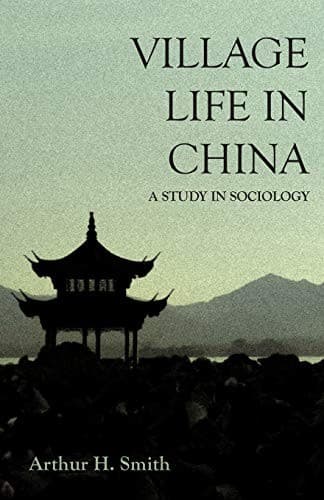
Village Life in China: A Study in SociologySmith, Arthur H.
General
Village Life in China: A Study in Sociology
Smith, Arthur H.
China -- Social life and customs; Villages
It was a shrewd suggestion of a philosopher that if we wish to understand
a people, we should note what things they take for granted. The
pre-suppositions of a Chinese villager are the same as those of his
ancestry near and remote. There is in a Chinese village as such no
intellectual life. If there happen to be literary men living in it, they
form a little clique by themselves, largely out of relation to their
neighbours, and likewise to most of their own families. It is an ancient
aphorism that "Scholars talk of books--butchers of pigs." We have already
abundantly seen that the processes of Chinese education are narrowing
processes, fitting the accomplished student to run only in grooves. It is
almost incredible how narrow these ruts become. Each literary examination
is a crisis at which one either becomes a graduate or does not; in either
case the result, whether appertaining to the student himself, the pupils
whom he has coached, or his own sons, is contemplated purely as a personal
and an individual matter. It is a literary lottery upon which much has
been risked, and out of which it is desirable to recover if possible a
prize. If that is out of the question all interest in the literary
business is at an end.
Unlike his representative in Western lands, the Chinese village scholar is
not a centre or source of illumination to others. His life is the ideal of
"subjectivity"--the quintessential essence of selfishness. It is a
venerable superstition of the Chinese that though the graduate does not
emerge from his own door, he knows the affairs of all under heaven. As we
have already had occasion to point out, among the many rhetorical
exaggerations of Chinese proverbial philosophy this aphorism may be held
to take the lead. The typical scholar knows nothing whatever about
all-under-heaven. He has no decided opinions one way or the other as to
whether the earth is round or flat, for it is no concern of his. Neither
is the current history of his own country. National affairs belong to the
mandarins who get their living by them; what have such matters to do with
a literary man who has taken his degree?
The writer is acquainted with an ex-schoolmaster who went into a business
which often led him to a distance from home. About a year after peace had
been concluded with Japan, this much-travelled merchant inquired during
the progress of a call if we could inform him how the war turned out,
explaining that he had heard such contradictory accounts at the capital of
his province and at Tientsin that he knew not what to believe, and had
judiciously held his mind entirely in suspense until he had an opportunity
to see his foreign friend, who might, he thought, know for certain!
Public-domain text, read in full here on John Shaqi.
Reviews
Reviews
No reviews yet
Be the first to share your thoughts on this work.
Elsewhere in the archive
Join the Discussion
Join the discussion
Sign in to leave a comment or review.
Sign InorCreate an account