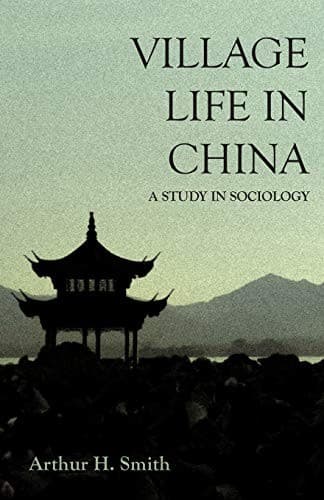
Village Life in China: A Study in SociologySmith, Arthur H.
General
Village Life in China: A Study in Sociology
Smith, Arthur H.
China -- Social life and customs; Villages
We have already mentioned that the villager who has been far from home is
a conspicuous exception to the general vacuity of mind so often to be met.
He has a rich and a varied experience which he is willing although not
forward to relate. But it is a striking fact that the man of this sort
when he returns to go abroad no more, tends speedily to relapse into the
prevailing type. He may have been in every one of the Eighteen Provinces,
or possibly in foreign lands, yet on his settling down to his old ways he
has no more curiosity to know what is going on elsewhere, than a man who
had at some time in his life been shipwrecked would have to know what had
become of the schools of fish with which for a time he was in fortuitous
proximity. When it is considered how vast a proportion of the whole
population live in villages, and when we contemplate in detail the
meagreness and poverty of the mental output, an impressive conception is
gained of the intellectual barrenness of the Flowery Empire. The phenomena
which we everywhere see are the outward expression of inner forces which
have been at work for more than two thousand years. The longer they are
considered and the more thoroughly they are understood the more profoundly
will it be seen and felt that the "answer to Confucianism is China."
XXV
UNSTABLE EQUILIBRIUM OF THE CHINESE FAMILY
The family is the unit of Chinese social life and, as we have often had
occasion to observe, the Chinese Family is a highly complex organization,
with many aspects which sometimes appear mutually contradictory. To the
consideration of one of these polyhedral faces we now turn, asking the
reader to bear well in mind that while what we have to say contains
important truth, this is but one out of many points of view.
The instability of the equilibrium of the Chinese family arises from its
constitution, from its environment, and from the relation between the two.
Let us first glance at some of the exterior causes. In a large portion of
the empire the rain-fall is more or less uncertain, rendering famine a
perpetual possibility. Within the past quarter of a century foreigners in
China have had superabundant opportunities to study the phenomena of
famine upon a great scale. The misery thus occasioned is inconceivable,
but we wish to refer only to the resultant disruption of families. Nothing
is more common than to find that the father has gone to some distant
region hoping to secure a bare sustenance leaving the wife and children to
shift for themselves. This is not because he does not care for them, nor
because he desires the separation, but because there is literally "no help
for it."
Public-domain text, read in full here on John Shaqi.
Reviews
Reviews
No reviews yet
Be the first to share your thoughts on this work.
Elsewhere in the archive
Join the Discussion
Join the discussion
Sign in to leave a comment or review.
Sign InorCreate an account