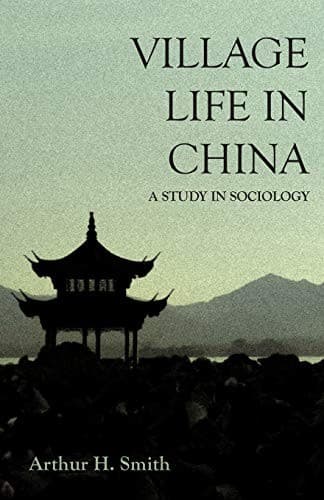
Village Life in China: A Study in SociologySmith, Arthur H.
General
Village Life in China: A Study in Sociology
Smith, Arthur H.
China -- Social life and customs; Villages
Large portions of the empire are liable to inundation, often with little
or no warning. Those who contrive to save themselves wander off whither
they can, generally in family groups, but not infrequently one by one.[7]
Children are born and children die on these haphazard journeys nowhither.
The elders die too, and sometimes a marriageable girl is disposed of for
life to some husband who could not afford the expense of an ordinary
wedding. It is proverbial that there are no ceremonies for a second
marriage, and whenever a family is broken up, it is highly probable that
all the widows will soon find partners, the union liable to be
discontinued whenever there is again a scarcity of food.
Political disturbances which often rise to the dignity of small rebellions
operate in the same way as famines and floods. In any of these cases
families once widely dispersed are not likely again to recombine.
It is not in times of special stress only that families are parted. In
several of the provinces of China a considerable proportion of the adult
males earn their living at great distances from home.
Myriads of Chinese from the northern portion of China get such a
livelihood as they can in Manchuria or elsewhere beyond the Great Wall,
hundreds or thousands of miles from home, to which multitudes never
return. Innumerable Chinese mothers never learn what has become of their
sons, who went away in early youth to be heard of no more. Communication
is irregular and uncertain, and uniformly untrustworthy. No wonder the
current adage declares that when the son has gone a thousand miles the
mother grieves.[8] The Chinese Enoch Arden perhaps returns from an
absence of possibly ten or it may be twenty years, enters his house,
throws down his bundle and without a question or a greeting to any one,
proceeds to take a solacing smoke. He may have been away so long that no
one recognizes him, and perhaps he is taken for a tramp and warned off.
But he merely replies "Why should I not make myself at home in my own
house?" and resumes his smoking, leaving details to be filled in later.
Public-domain text, read in full here on John Shaqi.
Reviews
Reviews
No reviews yet
Be the first to share your thoughts on this work.
Elsewhere in the archive
Join the Discussion
Join the discussion
Sign in to leave a comment or review.
Sign InorCreate an account