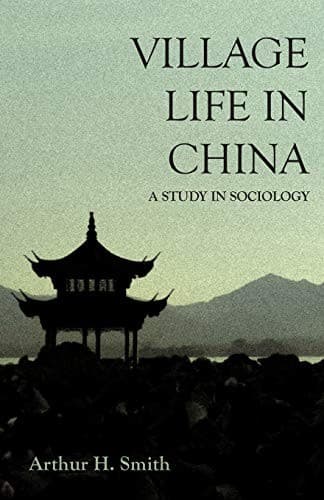
Village Life in China: A Study in SociologySmith, Arthur H.
General
Village Life in China: A Study in Sociology
Smith, Arthur H.
China -- Social life and customs; Villages
In the families of the poor there is no margin of any kind for sickness,
but sickness comes impartially to every grade of life. When the
bread-winner is laid aside, when the mother of a little flock is no longer
able to keep the simple domestic machinery in motion, then indeed trouble
has arrived. If a young married woman is sick, the first step is to send
for her mother; for ordinarily no one in the family into which she has
married has the time or disposition to take care of her, least of all the
husband, who regards himself as aggrieved by her disability, and who is
often far more inclined to expect the family of his wife to bear all the
resultant expenses, than to meet them himself. One of the legal occasions
for divorce is chronic illness, although we have never heard of a single
instance where formal steps were taken for that reason. It is a current
saying that in the presence of a long continued sickness there is no
filial son. How great the family strain often is, there are many things
to prove. In the midst of it all one is sometimes agreeably surprised to
find an amount of tenderness and forbearance worthy of all praise. But in
the constitution of Chinese society these exhibitions are and must be in a
great minority. A man well known to the writer in speaking of the serious
symptoms of a disease of his wife, remarked that he had asked her how long
she expected to keep up the groans called forth by the intolerable agonies
of terrible and incurable ulcers, and that for his part he had offered to
provide her with a rope that she might relieve him of his inconvenience,
and herself of her miseries, though upon being remonstrated with for such
an inhuman view of the case, he frankly admitted that his troubles had
made him "stupid." It is a significant saying in such instances that the
sufferer although poor has contracted a rich man's malady.
The disintegrating forces which operate in the Chinese family are more
efficient in the homes of the poor than of the rich, because there is less
power of resistance. But there are two of these agencies which imply a
certain degree of prosperity ere they can be fully developed, the gambling
and the opium habit, twin vices of the Chinese race. Each leads by swift
and relentless steps to destruction, and in each case there ensues at last
what is virtually a paralysis of the will, making amendment impossible.
Against these gigantic evils there is in Chinese society no safeguard
whatever, no preventive influences, and no remedies. It would be easy to
illustrate in terrible detail how these forces act insidiously,
universally and irresistibly. The wonder is that the track of devastation
is not even wider. They take rank among the most destructive
instrumentalities in Chinese social life. It is very rare indeed to hear
of reform from either of these vices, when there has been no impulse
imparted from without, and it is rarer that there is any one who can and
who will impart it.
Public-domain text, read in full here on John Shaqi.
Reviews
Reviews
No reviews yet
Be the first to share your thoughts on this work.
Elsewhere in the archive
Join the Discussion
Join the discussion
Sign in to leave a comment or review.
Sign InorCreate an account