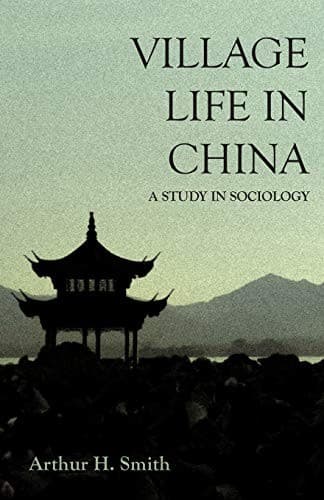
Village Life in China: A Study in SociologySmith, Arthur H.
General
Village Life in China: A Study in Sociology
Smith, Arthur H.
China -- Social life and customs; Villages
The equilibrium of every Chinese family is liable to be disturbed by an
evil which may not unlikely work more mischief than an ordinary
earthquake--to wit, a lawsuit. There is not a day in the life of any
Chinese when his peace, his prosperity, and possibly his life may not be
endangered by some complication for which he is not in any way
responsible, but from which escape is practically impossible. Let not the
reader suppose that most Chinese are entangled in the meshes of the law,
for this is not the case. But there is always the unavoidable liability. A
moment of uncontrollable passion on the part of any one of a score of
persons, may precipitate a crisis involving the expenditure of the greater
part of one's resources, subjection to protracted detention in jail, to
torture, to punishment of immeasurable barbarity, and to virtual
starvation in prison unless the means of the family are drained to prevent
it. Not every lawsuit has within it such phenomena as these, but they are
everywhere potential, for no one can predict where or how any suit will
end. It is not alone the principals who suffer in cases of this sort, for,
as the current saying runs, "When one family has trouble none of the four
neighbours are in peace."
Attention has been repeatedly called to the familiar fact that practically
no Chinese can maintain financial independence. To a foreigner nothing is
more amazing than the reckless manner in which a debt is contracted which
subsequently proves to have within it the fruitful seeds of ruin for the
whole family. It is vain to ask why the money was borrowed. One might as
well inquire why one is so wet who has been out all night in a Scotch
mist. Ages of experience have made the Chinese relentless creditors, and
woe to him who owes but cannot pay. China is full of small dealers with a
limited capital, who do well enough in ordinary years. A very small
percentage contrives to get so far ahead as to buy land, and thus the
family is rooted to the soil. But a far larger number lose the capital
invested, are obliged to sell their little holdings to pay their dues, and
thenceforth they join the great, hopeless, landless class. A single
failure of one important crop may carry with it consequences of this kind
to many small dealers. In China the man or the family which is loaded with
a debt beyond the recuperative power of the debtor, finds itself upon an
oiled toboggan-slide at the bottom of which is remediless ruin.
Public-domain text, read in full here on John Shaqi.
Reviews
Reviews
No reviews yet
Be the first to share your thoughts on this work.
Elsewhere in the archive
Join the Discussion
Join the discussion
Sign in to leave a comment or review.
Sign InorCreate an account